Relic point Vietnam
Việt Nam
Dinh Co
Dinh Cô, now located in Long Hai commune, Ho Chi Minh City, is a historical and cultural relic associated with the maritime beliefs of the local people. According to legend, Dinh Cô is dedicated to Le Thi Hong, also known as Thi Cach, a girl from Binh Dinh province who died at sea at the age of 17. Her remains were buried on Co Son hill. Later, folklore recounted that she appeared many times, helping fishermen overcome accidents and epidemics, so the people built a temple to worship her, honoring her as the Long Hai Goddess. Dinh Cô was initially a small temple by the sea, but was later moved to the foot of Thuy Van mountain and rebuilt more solidly. The complex includes the shrine at the foot of the mountain and her tomb on Co Son hill. The main hall has a traditional temple-like architecture with many dragon, tiger, and two dragon motifs, as well as a rich system of statues and altars. Every year, the Dinh Cô Festival takes place from the 10th to the 12th of February in the lunar calendar, including rituals such as welcoming the Water Goddess, welcoming the God, offering sacrifices to the Goddess, singing traditional folk songs, performing the "Dai Boi" ritual, and many folk games. The festival expresses gratitude to the deities revered by the coastal people and the hope for favorable weather, national peace and prosperity, safe voyages for fishermen, and successful catches. Dinh Cô was recognized as a national historical and cultural relic in 1995, and is a typical destination for learning about the religious life and maritime culture of Southern Vietnam. Source: Vietnam Law Newspaper Online
Ho Chi Minh City
16 view
Rating : National Monument
Giac Vien Pagoda
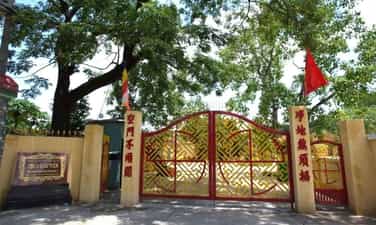
Located on Lac Long Quan Street, Binh Thoi Ward, Ho Chi Minh City, Giac Vien Pagoda is one of the representative ancient pagodas of the Gia Dinh - Saigon region, with a history closely linked to the construction and restoration of Giac Lam Pagoda. Its predecessor was Quan Am Vien, built in 1805 in the Ho Dat wharf area. In 1850, Quan Am Vien was renamed Giac Vien Pagoda. Through numerous restorations, the pagoda has gradually perfected its architectural and artistic appearance to its present state. Giac Vien Pagoda features Southern Vietnamese Buddhist architecture, harmoniously combining traditional elements with some Western influences in its facade decoration. However, the most outstanding value of the monument lies in its system of statues, decorative panels, horizontal plaques, couplets, and elaborately crafted wooden reliefs, particularly those from the late 19th and early 20th centuries. The pagoda currently houses 153 wooden statues, including many sets of high artistic value such as the Eighteen Arhats, the Ten Kings of Hell, and the Buddha and the Four Assemblies. The statues clearly demonstrate a free and expressive style, close to the daily life of the people of Southern Vietnam. Most remarkable is the system of 58 decorative panels with diverse themes. The "Ba Dieu" panel stands out for its exquisite carving, depicting nearly 100 species of birds in various lively poses. Besides familiar figures like dragons, unicorns, turtles, and phoenixes, the artisans also incorporated images close to everyday life such as buffaloes, cows, goats, pigs, dogs, birds, flowers, and fruits. These rustic images create a unique character, clearly showing the process of the Southern Vietnamese adaptation of Buddhist decorative art. The pagoda also has a system of 128 couplets and many reliefs carved on the columns and wooden structures. The themes are diverse, ranging from the Four Sacred Animals, the Eight Immortals, and the Eighteen Arhats to flowers, birds, trees, fruits, and familiar animals. Through this, the art of carving not only served religious needs but also reflected the life, thoughts, and aesthetic concepts of the inhabitants of the ancient Gia Dinh region. Source: Vietnam Buddhist Forum
Ho Chi Minh City
12 view
Rating : National Monument
Binh An Temple
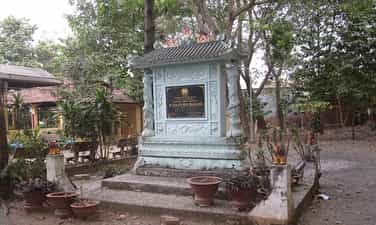
Binh An Temple is located in Dong Hoa Ward, Ho Chi Minh City, and is a valuable historical and cultural relic of the ancient land of Binh An. The communal house was built before 1852 and was granted royal status under the reign of King Tu Duc. This is the place to worship Thanh Hoang Bon Canh, expressing the tradition of folk beliefs and the ethics of local people when drinking water, remember its source. In 1945, the communal house was burned down by the French colonialists, and in 1950 it was rebuilt. After many restorations, the communal house still retains traditional cultural features and the tomb of Mr. Truong Cong Can, a talented general of the Nguyen Dynasty. In particular, during the years of resistance against the French colonialists, Binh An Temple was a place of refuge, meeting and gathering for local revolutionary soldiers. Therefore, the relic not only carries cultural and religious value but also marks the years of revolutionary struggle of the people here. On October 14, 2009, Binh An Temple was recognized as a provincial-level historical and cultural relic. Today, this place is a place that contributes to preserving traditional cultural values and educating the young generation about the history and traditions of the homeland. Source: Center for Trade, Tourism and Industrial Development Promotion of Binh Duong Province (Ho Chi Minh City)
Ho Chi Minh City
495 view
Rating : Provincial level relics
Mach Mang Stream
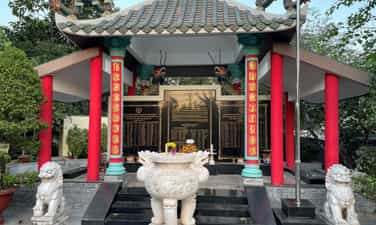
Mach Mang Stream (also known as Suoi So) in Tan Binh ward, Di An city, Binh Duong province, now Ho Chi Minh City, is a historical relic associated with the fierce anti-dumping battle on May 4, 1968 during the resistance war against the US. Here, the main force, militia and local guerrillas fought tenaciously against a large-scale attack by American and puppet troops with the support of aircraft, tanks and artillery. After more than a day and night of fighting, our army and people repelled many attacks, destroyed many enemy soldiers and burned 4 tanks. However, hundreds of officers, soldiers and people heroically sacrificed their lives. Since then, the stream has also been called Skull Stream by people to remember the great loss and pay tribute to those who died for national independence. Today, the Suoi Mach Mang memorial stele is a red address to educate patriotic traditions, reminding generations of the indomitable spirit and sacrifice of our ancestors. Source: Ho Chi Minh City Newspaper and Radio and Television
Ho Chi Minh City
537 view
Rating : Provincial level relics
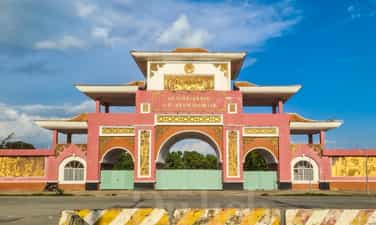
Ho Lang Base historical site
Ho Lang Base historical site. Ho Lang Base historical site is located in Tan Dong Hiep ward, Ho Chi Minh City. This was an important revolutionary base in the two resistance wars against the French colonialists and the American imperialists, associated with the heroic fighting tradition of the army and people of Di An region. Ho Lang has hilly terrain, surrounded by streams and dense forests, creating a strategic location favorable for building revolutionary bases. From here you can observe a large area, especially the Bien Hoa military airport area and important traffic routes. Thanks to that advantage, Ho Lang became the place to stand, command and organize many activities of revolutionary forces during the resistance period. During the resistance war against the US, Ho Lang was the place where many typical battles of local guerrilla forces took place. In 1966, Tan Hiep's army and people repeatedly repelled raids by American troops, destroying many enemy forces and confiscating many weapons. By 1971, the Di An District Party Committee continued to base itself in Ho Lang to lead the revolutionary movement. The protection and support of local people and the secret signal system have contributed to the safety of cadres and revolutionary forces operating. Currently, the relic still retains some vestiges such as bunkers, fighting pits and the natural terrain of the base. This is a vivid testament to the art of people's war, the spirit of solidarity and the resilient will of the army and local people in the struggle for national liberation. Source: Binh Duong Trade, Tourism and Industrial Development Center.
Ho Chi Minh City
459 view
Rating : Provincial level relics
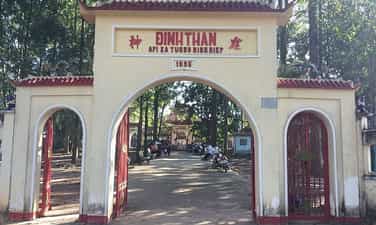
Temple of Tuong Binh Hiep
Temple of Tuong Binh Hiep. Tuong Binh Hiep communal house is located in Tuong Binh Hiep ward, Ho Chi Minh City. This is a valuable historical and cultural relic, as well as a special communal house in the South dedicated to Phan Thanh Gian - the first doctor of Cochinchina and a typical cultural celebrity, poet, and historian of Vietnam. Phan Thanh Gian was born in 1796 and worked as a mandarin under three dynasties of Kings Minh Mang, Thieu Tri and Tu Duc. He held many important positions in the royal court and was sent many times as ambassador to China, Indonesia, Singapore, France and Spain. He was also a participant in diplomatic activities to protect the country's sovereignty and interests in the turbulent historical context of the 19th century. After three provinces in the Western region of Cochinchina fell into the hands of the French colonialists in 1867, Phan Thanh Gian chose to commit suicide to express his loyalty, patriotism and sense of responsibility before the country's destiny. In 1924, King Khai Dinh granted him the title of deity and allowed local people to worship at Tuong Binh Hiep communal house. Today, Tuong Binh Hiep communal house is not only a place for people's religious activities but also a place to preserve and commemorate the merits of Phan Thanh Gian. Source: Binh Duong Trade, Tourism and Industrial Development Center.
Ho Chi Minh City
409 view
Rating : Provincial level relics
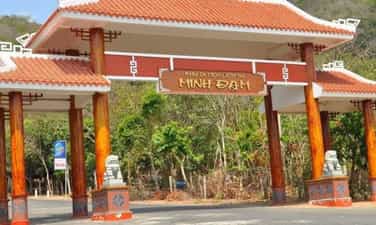
Minh Dam Mountain historical relic site
Minh Dam Mountain historical relic site. Minh Dam Mountain historical relic site is located in Long Hai, Phuoc Hai, Tam Phuoc and Long My communes, Ho Chi Minh City. The mountain range is about 8 km long, 355 m high, with rugged terrain, many caves and natural forests. Not only does it have beautiful scenery, this place is also an important revolutionary base in the two resistance wars against the French colonialists and the American imperialists. Thanks to its dangerous terrain with more than 300 large and small caves, Minh Dam Mountain was chosen by the revolutionary forces as an operating base. Many agencies and units used to be located here such as the District Party Committee, Military Medicine, Military Ordnance, District Army, along with the areas of Da Che, Da Chong, Chua Vien and Gieng Gach Pagoda. The stone caves, Hoang Cam kitchen, bunkers and traces of officers and soldiers' activities are still preserved, becoming evidence of a period of arduous but heroic fighting. The name Minh Dam is derived from the names of two revolutionary soldiers Bui Cong Minh and Mac Thanh Dam, who heroically sacrificed their lives on November 17, 1948. Naming the mountain after two martyrs shows gratitude and remembrance for those who devoted themselves to national independence. Today, the relic site also has the Martyrs' Memorial Temple, where more than 2,600 martyrs who fought and died for the Fatherland are registered. This is a red address with special significance in educating patriotic traditions, national pride and revolutionary spirit for today's generations. Source: Ha Tien Tourism
Ho Chi Minh City
454 view
Rating : National monument
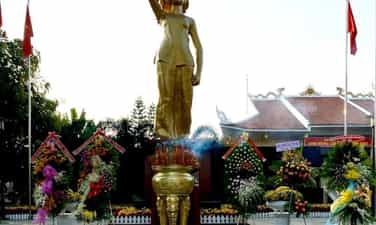
Monument Park - Temple of Heroic Martyr Vo Thi Sau
The historical relic site of Monument Park and Temple of Heroic Martyr Vo Thi Sau is located in Dat Do district, Ba Ria - Vung Tau province, now Ho Chi Minh City, formerly known as Dat Do Police Subdivision during the war. Ms. Vo Thi Sau was born in 1933 in Phuoc Tho commune. At the age of 14, she joined the Dat Do Assault Police team, bravely performed reconnaissance missions and participated in many dangerous battles, notably throwing grenades to disperse the enemy's attack at Dat Do market in 1948. In early 1950, due to a grenade falling apart in another attack, she fell into the hands of the enemy. Even though she endured many brutal tortures in prisons, she still maintained her revolutionary spirit. In April 1951, the French colonialists sentenced her to death when she was underage and secretly took her to Con Dao. At dawn on January 23, 1952, she was taken to the shooting range. She resolutely refused to be blindfolded, sang the song Tien Quan Ca and bravely sacrificed herself at the age of 19. To remember the gratitude, in the period 1980–1986, the locality built Monument Park with a 6m high bronze statue made by sculptor Tran Thanh Thanh. By 2001–2003, the 960 m² Temple continued to be completed right behind the monument to store documents and welcome visitors. Ms. Vo Thi Sau was posthumously awarded the title Hero of the People's Armed Forces in 1993. According to: Information portal of Ho Chi Minh City Department of Tourism
Ho Chi Minh City
311 view
Rating : National monument
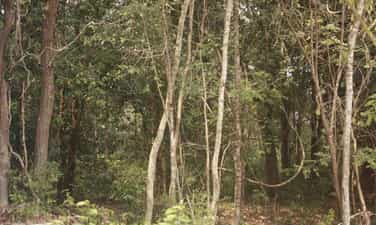
Kien An Forest revolutionary base
Kien An Forest - Revolutionary red address Kien An historical forest is located in An Lap commune, Dau Tieng district, former Binh Duong province, now Ho Chi Minh City, with an area of about 245 hectares. With its green natural landscape and rich revolutionary tradition, this place is one of the typical resistance bases of the Southeast region, as well as a meaningful tourist destination. During the two resistance wars against the French colonialists and the American imperialists, Kien An forest served as a strategic base for many revolutionary units. Thanks to the rugged jungle terrain, located between the Saigon River and Thi Tinh River, this place became a place to garrison troops, protect headquarters, train forces and be a springboard for many important battles towards Saigon. Kien An Forest was also the base of the security forces of Thu Dau Mot province, contributing to protecting the liberated area and effectively supporting the revolutionary movement. Today, the monument has been invested in building many items such as a welcome gate, a traditional exhibition house, a battle tunnel recreation area and a green tree system for sightseeing and studying. In 2004, Kien An forest revolutionary base was recognized as a provincial historical relic, becoming a red address to educate patriotic traditions and national pride for generations. Source: Binh Duong Province Electronic Information Portal (Ho Chi Minh City)
Ho Chi Minh City
305 view
Rating : Updating

Ngoc Hoang Pagoda (Dien Ngoc Hoang)
Ngoc Hoang Pagoda is the common name of Dien Ngoc Hoang, the name is Phuoc Hai Tu (the French is called Da Kao Pagoda); Currently located at 73 Mai Thi Luu Street, Da Kao Ward, District 1, Ho Chi Minh City. The temple was originally a Jade Emperor's altar, built by a man named Luu Minh (Luu Dao Nguyen, Guangdong, China) in the early 20th century. In 1982, Venerable Thich Vinh Khuong came to take over the temple. Since then this temple belongs to the Vietnam Buddhist Church. In 1984, the Ngoc Hoang Dien was renamed "Phuoc Hai Tu". Ngoc Hoang Pagoda is an ancient temple, following the Chinese temple style with a brilliant decorative motif. The pagoda built bricks, roofed roofs of yin and yang tiles, decorated the roof, the corner of the roof with many colored ceramic statues. In the pagoda there are many works of art: worshiping, statues of worship, bao Lam, lam, incense ... with materials: wood, ceramics, paper. The temple campus is about 2,300 m2. In the front there is a small temple to put the guardian statue. Tam Quan gate stands out with the winding lines of the two dragons in the "Painting" position. The main palace of the Jade Emperor, Huyen Thien Bac De with Thien Binh and Thien General. There is a coordination to worship the Bodhisattva, the great Bodhisattva and some familiar gods in the beliefs of the Chinese such as: God of Thien Loi, the god of the Guan (the god of the door), the Earth God (the land of the land), the god of the army (the god of the kitchen), the god of Ha Ba (the god of the river), the Van Xuong and the god of La Dong Tan (the god of literature), the Thai Tue (the star of the body) Imperial god ... In general, the statues of worship in the church are all beautiful wooden sculptures. Every day guests at home and abroad come to worship the temple very crowded. The biggest festival is Jade Emperor takes place on January 9 (lunar calendar) every year, it is said that the birth of the Jade Emperor. On October 15, 1994, Ngoc Hoang Pagoda was recognized as a national architectural and artistic monument. Source of electronic portal in District 1, Ho Chi Minh City.
Ho Chi Minh City
5405 view
Rating : National relics.