Relic point Vietnam
Việt Nam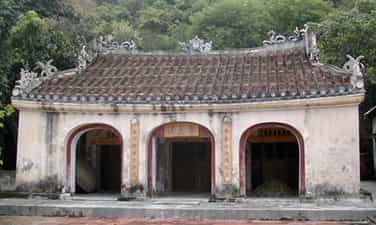
Tan Hiep Tien Thanh Communal House
Tan Hiep Tien Hiep Communal House - A relic marking the merit of establishing the village on Cu Lao Cham Tan Hiep Tien Hien Communal House (local people often call Tien Hiep Mausoleum) is located in Bai Lang village, Tan Hiep commune (Cu Lao Cham), Hoi An city, Quang Nam province. This is a typical religious structure of the island's residents, built around the end of the 18th century to worship the ancestors and descendants who had meritorious efforts to destroy and establish villages, and at the same time worship the gods protecting fishermen in their lives and making a living at sea. According to historical documents, Cu Lao Cham has long held an important position at the sea gateway of Hoi An, where domestic and foreign ships often stop to get fresh water, firewood and shelter from the wind before continuing their voyage. The formation of the island community is associated with the process of reclamation, hamlet establishment and marine industry development. Therefore, building a communal house to commemorate ancestors as well as pray for a calm sea is a cultural beauty that has been passed down through many generations. The communal house was built in a typical arched architectural style, using local materials such as stone, brick, coral, lime mortar; The roof is covered with yin and yang tiles. The roof is decorated with the shape of "two dragons painting pearls", the blade's head is softly curved with floral motifs, dragon faces and fish tails, reflecting the interference between traditional architectural art and island culture. The space inside is spacious, divided into many worship areas. The main space has tablets worshiping Phuc Ba General and a number of gods related to the marine industry. According to ancient beliefs, "Phuc Ba" is a title given to generals who have conquered waves or are talented at navigation, and are worshiped by people as gods protecting fishermen on every trip to sea. With unique historical, cultural and architectural values, Tan Hiep Tien Hien Communal House was ranked a National Monument in 2006. Source: Hoi An Cultural Heritage Management and Conservation Center.
Da Nang
5 view
Rating : National monument
The tomb of King Quang Trung's concubine and Tay Son generals
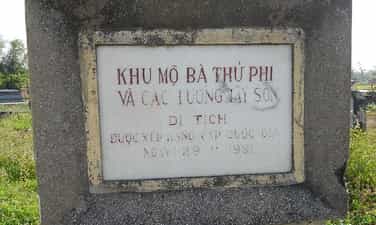
The tomb of King Quang Trung's concubine and Tay Son generals The tomb of King Quang Trung's concubine and Tay Son generals is located in Thanh Dong village, Cam Thanh commune, Hoi An city, Quang Nam province. The relic is located on Rung Ray mound, where concubine Tran Thi Quy and a number of generals and mandarins of the Tay Son dynasty of the Tran Thanh Chau clan are buried. According to the Tran family genealogy and local documents, Tran Thi Quy was from Thanh Chau village and was recruited by King Quang Trung to be his concubine. After the Tay Son dynasty collapsed, she returned to her hometown to live and was buried in Cam Thanh. In the tomb area there are also the tombs of Tran Cong Thuc - Grand Admiral, Grand General and many other members of the Tran clan who held positions under the Tay Son dynasty. The tomb area not only reflects the typical ancient tomb type of Hoi An but also demonstrates the role of Thanh Chau village and the Tran clan in the Tay Son movement. This is a valuable source of information for researching local history and the late 18th century. In 1991, the tomb of King Quang Trung's concubine and Tay Son generals was ranked as a national historical relic. Source: According to Hoi An Cultural Heritage Management and Conservation Center.
Da Nang
6 view
Rating : National monument
Le clan's tomb
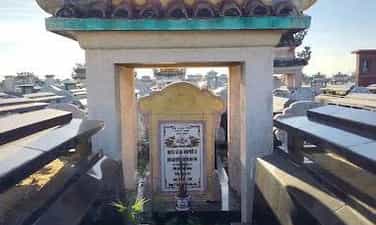
Le clan's tomb - A relic marking the process of colonizing the land of Cam Thanh The Le clan's tomb is located in Thanh Dong village, Cam Thanh commune, Hoi An city, Quang Nam province. This is the burial relic of the ancestor of the Le clan - Mr. Le Duy Tri, a fifth-generation descendant of the Later Le dynasty, who came to Thanh Chau to settle down in the early 17th century. According to historical documents, Mr. Le Duy Tri is the eldest son of The Tong Emperor Le Duy Dam, brother of King Kinh Tong Le Duy Tan. In 1623, due to political upheaval and persecution by Lord Trinh Tung, he and his family went to the South, stopping in the Thanh Chau area (now in Cam Thanh commune). Here, he and his clan reclaimed land, established hamlets, developed production and became the sages who publicly reclaimed this land. The current tomb complex was built on a large scale in 1930 (the fifth year of Bao Dai). The tombstone is engraved with the names of the ancestors of the Le clan and recognizes their contributions to the exploration of ancient Thanh Chau lands. The monument is not only a place to commemorate ancestors but also an important testament to the process of migration and expansion of Dai Viet residents into Hoi An in the 17th century. With outstanding historical and cultural values, the Le ancestral tomb is a valuable source of material for researching the history of the formation of the Cam Thanh community in particular and Hoi An in general. The relic was ranked as a national historical relic in 1991. Source: According to Hoi An Cultural Heritage Management and Conservation Center.
Da Nang
4 view
Rating : National monument
Tomb of Japanese merchant Tani Yajirobei
The grave of Japanese merchant Tani Yajirobei located in Hoi An Dong, Da Nang City, is a testament to the trade relationship between Vietnam and Japan during the period when Hoi An was a busy international trading port in the late 16th and early 17th centuries. Mr. Tani Yajirobei, from Hirado (near Nagasaki), came to Hoi An to trade, settled and passed away here. The tombstone was established in 1647, clearly stating Japan's hometown, and is a precious document about the presence of the Japanese community in Hoi An. The tomb was built in the style of ancient Hoi An tombs with tombs made of traditional compounds from lime, seashells, mussel shells, molasses and Litsea sap to create high durability over hundreds of years. This is one of the valuable historical, cultural and architectural relics, contributing to demonstrating the economic and cultural exchange between Vietnam and Japan in history. The tomb was built on a high mound, facing Northeast according to traditional feng shui concepts. The work includes sandstone walls, saddle-shaped graves and sandstone tombstones. In 1991, the Tomb of Japanese trader Tani Yajirobei was ranked as a National Historical Site. Today, the relic is an attractive tourist destination, especially for Japanese tourists and those who love learning about the history of Hoi An trading port. Source: Hoi An Ancient Town
Da Nang
186 view
Rating : National monument
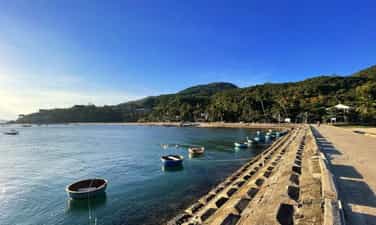
Temple of the Nest Craft Patriarch of Cu Lao Cham
Located in Bai Huong village, Tan Hiep commune, Cu Lao Cham (Da Nang city), the Nest Temple (Yen Nghe To Mieu) is a unique religious relic, associated with the history of formation and development of Thanh Chau bird's nest exploitation profession - a traditional profession with a history dating back to the 16th century. Not only is it a place to worship the ancestors who pioneered the bird's nest profession, the monument also reflects the strong bond between island residents and the natural resources and sovereignty of Vietnam's islands and islands. The temple was built on a large scale in 1848 (the first year of Tu Duc) by Mr. Ho Van Hoa and Thanh Chau village officials to worship the ancestors of the bird's nest exploitation profession and the gods protecting the profession. According to many historical documents, from Gia Long's reign, Mr. Ho Van Hoa was assigned to manage the exploitation of bird's nests on Cu Lao Cham and was honored by later generations as the Patriarch of the bird's nest profession. The monument was built on a sand mound about 150 meters from Bai Huong beach, with the front facing the sea. The architecture has a traditional style with three-entrance gates, scroll-style screens, two consecutive houses with yin-yang tiles and a system of exquisitely carved wooden rafters. The worship space holds many precious artifacts such as horizontal panels, gilded altars, tablets of ancestors and stone stele of the Tu Duc period, reflecting the historical, artistic and religious values of the coastal community. Coming to the Shrine of the Nest Craft, visitors will not only learn about the history of bird's nest exploitation - a famous traditional profession of Cu Lao Cham, but also have the opportunity to explore the cultural life of Bai Huong fishermen, listen to stories and legends about the bird's nest profession and feel the connection between people and the sea and islands over many generations. Every year, on the 10th day of the 3rd lunar month, the Nest Ceremony is solemnly held at the relic to commemorate the contributions of predecessors and pray for a favorable, peaceful and bountiful harvest season. Today, the festival is also combined with many cultural and tourist activities, contributing to promoting the Thanh Chau bird's nest exploitation profession - a national intangible cultural heritage, while raising awareness of preserving natural resources and promoting the value of the Cu Lao Cham - Hoi An World Biosphere Reserve. According to new newspaper
Da Nang
275 view
Rating : National monument
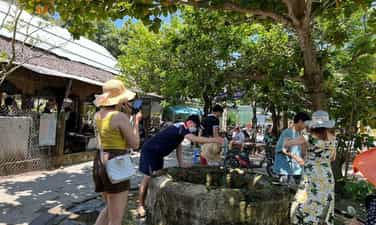
Ancient well of Xom Cam
Xom Cam ancient well - A mark of Cham culture in the heart of Cu Lao Cham Located in Cam village, Hoi An, Da Nang, Xom Cam ancient well is one of the typical ancient architectural works of Cu Lao Cham, associated with the history of formation and development of the island's residents for many centuries. This is not only a valuable source of fresh water but also a vivid testament to the cultural interference between the Cham and Vietnamese people on the Hoi An international trade port route. Archaeological results show that Cu Lao Cham was inhabited more than 3,000 years ago. By the 7th - 10th centuries, this place became the residence of the Cham people, as well as an important stop on the international maritime route, where vibrant trade activities took place with traders from China, the Middle East and many other countries. After the 17th century, the Vietnamese community came to live and continued to inherit, preserve and use the works built by the Cham people, including the ancient well system. Xom Cam Well has a bold Cham architectural style with a well mouth of about 1.18 m in diameter, 4.5 m deep, the well's bottom is built of bricks in the form of a "collar", bonded with traditional lime mortar. In particular, at the bottom of the well is a system of four ironwood bars assembled into a square shape, contributing to reinforcing the foundation and ensuring the sustainability of the project over hundreds of years. According to many ancient documents, during the prosperous period of Hoi An trading port, international merchant ships often visited Cu Lao Cham to replenish food and get fresh water from ancient wells on the island before continuing their journey. To this day, the Forbidden Hamlet Well is still full of water, clear and cool all year round, continuing to serve the daily life of local people, becoming a symbol of longevity and enduring vitality in the middle of the sea. Not only has historical and architectural value, Xom Cam Ancient Well also reflects the process of inheritance and cultural blending between communities on the island, contributing to the unique identity of the World Biosphere Reserve of Cu Lao Cham - Hoi An. With special historical, archaeological and cultural values, Xom Cam Ancient Well was ranked as a national historical relic by the Ministry of Culture, Sports and Tourism in 2006. Today, this is an attractive tourist destination, where visitors can learn about the long history of Cu Lao Cham, explore the traces of Champa civilization and feel the peaceful beauty of the island in the middle of the East Sea. According to Hoi An Ancient Town
Da Nang
622 view
Rating : National monument
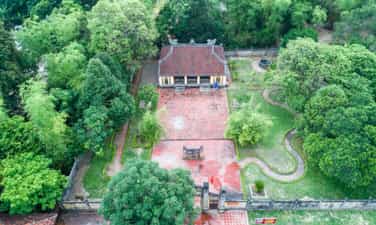
Ong Ich Duong memorial relic
The Ong Ich Duong memorial relic is associated with the life and sacrifice of Ong Ich Duong (1890–1908), a son of Phong Le village, now in Hoa Tho Tay ward, Da Nang city. He is the grandson of Mr. Ich Khiem and was born into a family with a patriotic tradition. He was soon famous for being chivalrous, good at literature and martial arts, and always on the side of the poor people. In 1908, responding to the anti-tax collection movement in Central Vietnam, Mr. Ich Duong led the people of Hoa Vang to participate in the fight against oppression. After the uprising failed, he was captured by the French colonialists and beheaded at Tuy Loan market when he was only 18 years old. Before his death, his courageous spirit and indomitable spirit became a symbol of patriotism and the will to fight for national independence. Mr. Ich Duong's sacrifice deeply moved the local people. People built a shrine right at the place where he died to commemorate the merits and spirit of this patriotic scholar. Over time, the relic area continues to be preserved and embellished with a memorial stele next to the historic banyan tree - a witness associated with the 1908 event. Today, Ong Ich Duong Memorial Monument is a red address that educates patriotic traditions and the spirit of revolutionary struggle for generations, and is also a destination to help tourists learn about the anti-tax collection movement in Central Vietnam and the history of the struggle of Da Nang people in the early twentieth century. According to: Da Nang Newspaper
Da Nang
575 view
Rating : National monument
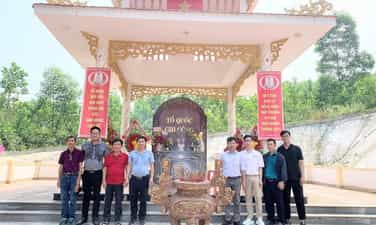
Revolutionary base area of Hoa Vang District Party Committee
Hoa Vang District Party Committee's revolutionary base is located in the triangle area of Phu Tuc - O Ray - Tong Coi mountains, in Hoa Vang ward. With rugged mountainous terrain, this place was once an important base for revolutionary forces in the two resistance wars against the French colonialists and the American imperialists. From the years 1947–1949, the Dong Xanh - Dong Nghe area was chosen as the location for the leadership of the Hoa Vang District Party Committee. By 1955, the Quang Da Provincial Party Committee built the Hoa Vang West wing revolutionary base (codename B1), turning this place into the center for directing the revolutionary movement of the western and northwestern regions. During this time, Da Nang Stone and Non Nuoc Stone became sacred symbols of patriotism and the will to fight resiliently. Since 1960, the triangle area of Phu Tuc - O Ray - Tong Coi continued to be chosen as the resistance base of the Hoa Vang District Party Committee. This is the workplace, direction and activity of many district leaders, and is also the venue for conferences, Party congresses, military and political training for revolutionary forces during the years of resistance against the US. The rugged mountainous terrain has contributed to shielding and protecting the headquarters against many enemy raids. During the two resistance wars, Hoa Vang District Party Committee Revolutionary Base played the role of an important leadership, command and rear base of the local revolutionary movement, associated with many historical events and activities of leading officials at the provincial, regional and district levels. To preserve those historical values, the relic site has been invested in building exhibition houses, memorial stele and other items for sightseeing. Today, this place has become a red address for educating patriotic traditions, commemorating previous generations of revolutionaries and a destination to help tourists learn about the history of the heroic struggle of Hoa Vang's army and people in the cause of national liberation. According to: Da Nang Newspaper
Da Nang
231 view
Rating : National monument
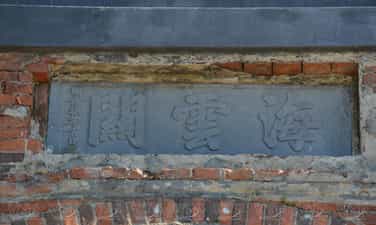
Hai Van Quan
Hai Van Quan is a defensive military project built in 1826, during the reign of King Minh Mang. The relic is located on top of Hai Van Pass at an altitude of about 496 m above sea level, at the border between Hue city and Da Nang city. This is a strategic location on the North - South traffic route, and is also the gateway to protect the capital Hue from the south. Since the time of the Nguyen Lords, Hai Van Pass has been considered a dangerous land, playing an important military and defensive role. When the Nguyen Dynasty chose Hue as its capital, this place was considered the "throat" of the country. Therefore, King Minh Mang built Hai Van Quan to control the Thien Ly road and strengthen the protection of the capital. The project includes two large city gates built of brick and stone in a rolling arch architecture. The gate facing Da Nang is engraved with three words "Hai Van Pass", while the gate facing Hue is engraved with six words "The most majestic pass in the world" - a praise for the majestic beauty and critical position of Hai Van Pass. Surrounding the gate is a solid wall system with military items such as garrisons, weapons warehouses and observation positions. Through many historical upheavals, especially during the French colonial period and the war, Hai Van Quan was converted into a military base, many original architectural items were destroyed or degraded. By 2017, the monument was ranked as a National Monument, and from 2021, Hue and Da Nang have coordinated to implement a restoration project, restoring important items, contributing to restoring the original appearance of the building. Today, Hai Van Quan is not only a historical relic of special value but also a famous stop on the Hai Van pass road. From here, visitors can enjoy a panoramic view of the mountains, the sea and one of the most beautiful coastal roads in Vietnam. With unique historical, architectural and landscape values, Hai Van Quan is a destination not to be missed in the journey to explore the Central region. According to: Vietnam News Agency
Da Nang
623 view
Rating : National monument
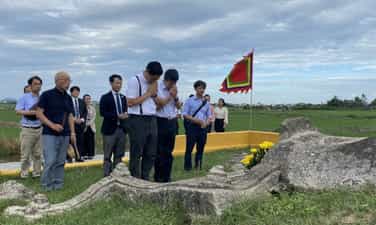
Tomb of Mr. Banjiro - Japanese businessman
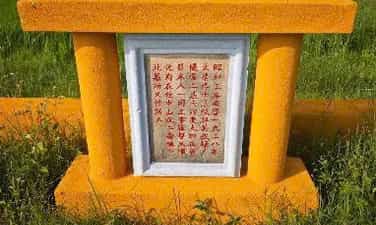
Tomb of Mr. Banjiro - Japanese businessman - Truong Le Block - Cam Ha Commune Mr. Banjiro was a Japanese businessman who died in Hoi An. The tomb is near the road from the old town down to An Bang beach and still retains the original traces of construction from the 17th century. The tombstone is dated 1665. Behind the tomb there is a cement stele engraved with Japanese characters, with the following content: "In the 3rd year of Showa (1928) at the suggestion of literature professor Kuroita Katsumi, a group of Japanese residing in Indochina (now Vietnam, Cambodia, Laos) asked Mr. Nakayama to supervise the repair of this tomb." Recently, Hoi An has continued to renovate and carefully preserve this tomb. The monument was ranked as a national monument in 1991. Mr. Banjiro's grave was built with a mixture of lime, sand, bark water, molasses... The grave is saddle-shaped, facing Northeast, measuring 190cm x 85cm. In front of the grave there is a stele made of rock salt, with two lines of words on both sides. Previously, this tomb had no one to look after or repair it. After the Ministry of Culture issued a decision to recognize Hoi An Ancient Town, this tomb site is regularly cared for by the Hoi An Monuments Management Board to preserve and repair. Currently, the tomb is regularly looked after by Mr. Nguyen Nuoc's family and burned incense. The relic contributes to clarifying the process of forming Hoi An Ancient Town, especially the period when Japanese traders came to Hoi An to trade. Source: Hoi An Ancient Town
Da Nang
202 view
Rating : National monument