Relic point Vietnam
Việt Nam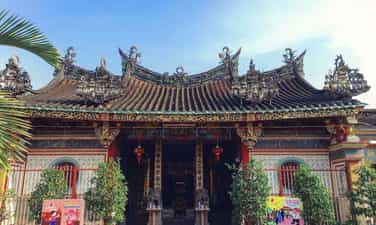
Kien An Cung (Ong Quach Pagoda)
Kien An Cung, commonly known as Mr. Quach Pagoda, is a temple located in the center of Sa Dec city (No. 39 Phan Boi Chau Street, Ward 1, Sa Dec city, Dong Thap province), facing the canal. Cai Son. The temple was built from 1924 to 1927 by Chinese people from Fujian. The pagoda has bold Chinese architecture, with an overall shape of the letter Cong consisting of three compartments: Dong corridor, Tay corridor and the main hall is larger. The tile roof consists of 3 layers, the top is tile, the middle is tile, and the bottom is tile. The tiles are roofed in dragon waves, covering the ground for the curved waves to rise high, creating a tile roof in the "five elements" style. Each end of the wave is a miniature palace, including 6 palaces. The entire pagoda There are no rafters, only wooden beams that bear the force on round wooden pillars. On the walls of the pagoda are images from Journey to the West, Romance of the Three Kingdoms,... At the entrance are two unicorns. made of very large green stone, above is a splendid lacquered and gilded diaphragm. In the middle of the main hall is the space to worship Quang Trach Ton Vuong. His statue is cast in red bronze with a kind face, holding a jade belt, next to two other gods. On his right side is the place to worship Patriarch Thanh Thuy, on the left is Bao Sanh the Great Emperor. The two outer rooms, Dong Lang and Tay Lang, are places to worship a number of other gods such as Quan Thanh De Quan... Above the altars there is a horizontal panel with four Chinese characters "Phu Bao An Dong". On both sides of the column are a pair of tureens: Dong village wishes the Holy Virtue to restore the Hao Trac Thanh palace Phu My thanked the gods and opened a magnificent temple Since its construction, the pagoda has been restored three times but is still located in the same location. Every year the pagoda has two major festivals on February 22 of the lunar calendar and August 22 of the lunar calendar, welcoming many visitors. With Chinese-style architecture and a unique traditional culture, Kien An Cung was recognized by the Ministry of Culture and Information as a national historical-cultural relic on April 27. 1990. Source: Dong Thap Tourism
Dong Thap
6916 view
Rating : National monument
Huynh Thuy Le ancient house
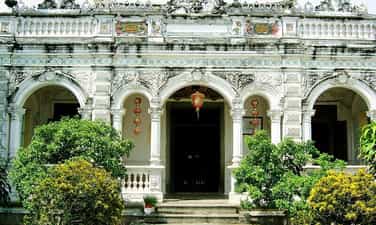
Huynh Thuy Le ancient house is located at 255A, Nguyen Hue street, ward 2, Sa Dec city, Dong Thap province. The ancient house was built in 1895 by Mr. Huynh Cam Thuan, a famous and wealthy Chinese businessman (Fujian, China) in Sa Dec in 1895 in the bustling shopping area along the Sa Dec river. The house was built with a unique combination of East and West architectural styles, especially this ancient house is also famous for being related to a borderless love affair between a French female writer named Marguerite Duras and a young man. Chinese-Vietnamese named Huynh Thuy Le, son of Mr. Huynh Cam Thuan - the owner of the house. In 1929, Marguerite Duras and Young Master Huynh Thuy Le met and fell in love at first sight. However, after 18 months of love, because of Mr. Huynh Cam Thuan's vehement opposition, this relationship had to end and Marguerite Duras had to decide to give up and return to France. Later, Huynh Thuy Le had to obey the family to marry a girl of Chinese origin. This love affair later became a memoir for her to write the famous novel The Lover in 1984. This work was adapted into the film L'Amant in 1992 by French director Jean-Jaques Annaud. Huynh Thuy Le ancient house is a harmonious combination of Eastern and Western architecture. The entire house is built on an area of 258 square meters and is shaped in the style of a traditional Vietnamese house, with a yin-yang tiled roof and two curved boat-shaped gables in the style of a Northern pagoda to create a soft look. roof. However, the architecture inside the house is tall and airy, the walls are built of very thick solid bricks from 30-40cm covering the wooden frame structure, increasing the load-bearing capacity in accordance with traditional French architecture. The house has three rooms, decorated inside in Chinese style. The balconies and railings are painted with gold and carved very similar to Chinese pagodas. The middle balcony frame has a double Loan Phung carving representing "Loan Phung Hoa Minh Sac Cam Dao" which means eternal happiness. . The frames on both sides are carved with birds, flowers and leaves, representing the family's prosperity. In particular, in the middle of the main house there is a worship of Quan Cong, a traditional Chinese belief; At the same time, it also shows strength and prosperity in life. The wooden doors, cabinets, beds, and altars are all carved very elaborately and delicately. In 2008, Huynh Thuy Le Ancient House was recognized as a Provincial Historical Site and in 2009 it was recognized as a National Historical Site. Source: Dong Thap Tourism
Dong Thap
7434 view
Rating : National monument
Xeo Quyt Relic Area
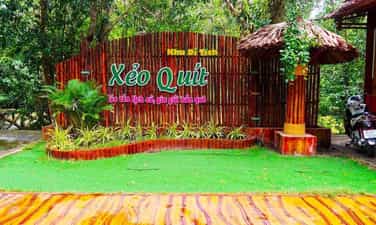
Xeo Quyt relic site is located on the territory of two communes My Long and My Hiep, Cao Lanh district, Dong Thap province, with a total area of 70 hectares. From 1960 to 1975, the Kien Phong Provincial Party Committee (now Dong Thap) chose this place as a base to lead the people of the province to join the whole country in successfully carrying out the resistance war against America to save the country. In the past, this place was a desolate, swampy land, full of weeds and alum-contaminated fresh water, full of mosquitoes and leeches. The accommodation and activities of the Provincial Party Committee mainly rely on the support and protection of the people around the area and must dig ditches to prevent enemy tanks, build fortifications and plant trees to create forests for shelter. and activity. Around this base, with a radius of 6 km, is an almost closed system of more than 10 enemy posts. Among them, there are two stations about 1 km from the base area. During the war, this place was a free range, free bombardment area, a "firing range" and a "helicopter training ground" for the enemy. Many times B52 aircraft, M113 amphibious vehicles, flying boats, artillery combined with enemy infantry continuously bombed, swept, and bombarded the base area, trying to destroy all life on this land. Therefore, Xeo Quyt became a very fierce war zone. There are times when the Provincial Party Committee has to face life and death narrowly. To operate and survive until the day of complete victory, on the one hand, the Provincial Party Committee has shown strategic intelligence, courageous perseverance, and endured hardships to cling to the land and people "not one inch, not one inch". to move", must have a suitable type of living to live and live well in the delta, delta, wet season (must travel and work on canoes)... On the other hand, the Provincial Party Committee's existence is due to a very good gesture. noble and beautiful: "Xeo Quyt lies right in the hearts of the people". This is a decisive factor for the survival and safety of the base. Therefore, today Xeo Quyt is called "THE BASE OF THE PEOPLE'S HEART". Xeo Quyt is divided into 2 areas: Area 1 is about 50 hectares, Area 2 is about 20 hectares. Area 1 is an area that preserves the historical and cultural values of the revolutionary base during the resistance war and the natural ecological diversity... Area 2 is the development area for business activities, tourism and picnic services such as: Restaurants, Conference Halls, outdoor food areas, recreational fishing, river experience games... Provincial Party Committee Hall - where many large conferences take place, proposing important policies and resolutions to lead the province's revolutionary movement; office of the clerical unit; combat fortifications, bomb shelters, secret bunkers, burial grounds, death grounds... Currently, Xeo Quyt has 170 species of plants (with 158 wild species) and 12 species of woody plants. Although not rare, they are adapted to flooded conditions. The fauna has 200 wild species including 7 species of frogs, 22 species of reptiles, 73 species of fish, 91 species of birds and 7 species of mammals. In particular, there are 13 rare animal species recorded in Vietnam's red book: pythons, cobras, box turtles, broad-billed citronella birds and common otters... Old cajuput carpets and populations of water hyacinths. These are two types that are now almost no longer found in other areas of Dong Thap Muoi. Many melaleuca trees with a lifespan of more than 30 years grow high, along with a system of vines clinging around, forming giant cone-shaped blocks. With those important historical marks, on April 9, 1992, Xeo Quyt was recognized as a national historical and cultural relic by the Ministry of Culture and Information. Source: Dong Thap Tourism
Dong Thap
7498 view
Rating : National monument
Go Thap relic site
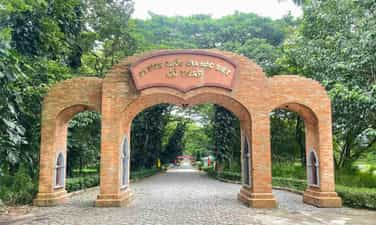
Go Thap special national relic site is located in hamlet 1, Tan Kieu commune, Thap Muoi district, Dong Thap province. Go Thap is considered a convergence of special cultural, historical, archaeological and spiritual values associated with each different historical period. - Archaeological cultural value: The earliest records of archeology at Go Thap relic site were around 1881, by Captain Silvestre - a French inspector working here. Up to now, through research, survey, exploration and excavation, Go Thap relic site has been identified by archaeologists as a small kingdom of the Funan kingdom. This place preserves almost intact relics of Oc Eo culture and Funan kingdom, with more than 10 architectural relics of Hindu temples, magic ponds, magic wells, roads and many residential relics. , workshop,... and many unique collections of artifacts such as: Hindu god statues (including 2 Vishnu statues recognized as National Treasures), wooden Buddha statues and especially a collection of more 400 gold artifacts including gold leaves, gold earrings, gold rings, gold necklaces,... have been confirmed by the Vietnam Records Organization as "The largest collection of Oc Eo - Go Thap gold artifacts in Vietnam" . - Historical value: Go Thap relic site has a "golden history" in the fight to protect the country. This place was once the "Headquarters" of two national heroes, Thien Protector Vo Duy Duong and General Nguyen Tan Kieu in the struggle against the French colonialists in the years 1862 - 1866. After 1945, Go Thap was "red address" of the resistance war against the French. This place was chosen by the Party Committee and the Southern Administrative Resistance Committee as a resistance base in the period from 1946 to 1949. During the resistance war against the Americans to save the country, Go Thap was also the place that marked the glorious victory against the Americans. The collapse of the Ten-Story Tower (Observatory) of the Ngo Dinh Diem government on January 4, 1960 by the army and people of Kien Phong province. - Spiritual cultural value: Go Thap relic area also stands out through its spiritual values with religious and belief relics with relics such as: Ba Chua Xu Temple, Hoang Co Temple, Temple Heavenly Protector Vo Duy Duong, Doc Binh Nguyen Tan Kieu Temple and Thap Linh Pagoda. Every year there are two traditional festivals: Ba Chua Xu on the full moon day of the third lunar month and the death anniversary of two national heroes Thien Protector Vo Duy Duong and General Nguyen Tan Kieu on the full moon day of the 11th lunar month. Each festival in Go Thap attracts hundreds of thousands of tourists from all over. In early 2018, the Truc Lam Zen Sect Management Board held a groundbreaking stone-laying ceremony to build Truc Lam Thap Muoi Zen Monastery at Go Thap Relic Site with a scale of 10 hectares, with the highlight being the 99m high Dinh Quoc Stupa. When completed, Truc Lam Thap Muoi Zen Monastery combined with existing relics will create richness and diversity to attract tourists and promote the development of spiritual tourism at Go Thap Relics Area. - Ecological value: Go Thap relic area also has an ecological area of more than 160 hectares that was recognized by the Ministry of Natural Resources and Environment as a biodiversity conservation area in 2015. The ecological area in Go relic area The tower is a place that preserves many wild features of the Dong Thap Muoi ecosystem with many endemic species of flora and fauna, which is considered the kingdom of lotus. Go Thap lotus with its pure beauty has entered poetry, becoming a symbol of Dong Thap province, so that every time Dong Thap is mentioned, people immediately think of two verses by poet Bao Dinh Giang: " Thap Muoi is the most beautiful lotus, Vietnam is the most beautiful named Uncle Ho. With those special historical, cultural and scientific values, Go Thap Relics was recognized by the Ministry of Culture and Information as a National Monument in 1989 and in 2012 was ranked as a Monument by the Prime Minister. Special country. Source: Dong Thap Tourism
Dong Thap
7075 view
Rating : Special national monument
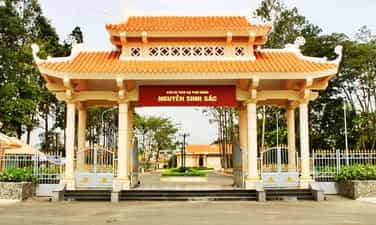
The relic site of Pho Bang Nguyen Sinh Sac
Nguyen Sinh Sac relic site is located at 137, Pham Huu Lau street, ward 4, Cao Lanh city, Dong Thap province. This is the resting place of Vice President Nguyen Sinh Sac, a patriotic Confucianist, and the father of President Ho Chi Minh. Nguyen Sinh Sac relic site was started construction on August 22, 1975 and inaugurated on February 13, 1977. On April 9, 1992, Nguyen Sinh Sac Relic Area was recognized by the Ministry of Culture and Information as a National Historical and Cultural Relic. Mr. Nguyen Sinh Sac was born and raised in Nam Dan, Nghe An province. In the year of Tan Suu (1901), he passed the Vice Ranking in 1906 and took the position of "Advocate of the Ministry of Rites" and then became Tri Phu in charge of Tri of Binh Khe district (Binh Dinh). During his time as a mandarin, he always stood on the side of the poor, punishing the evil tyrants and only served for a short time before being dismissed by the Nguyen Dynasty. After being dismissed, he went to the South and lived in Hoa An village in Dong Thap province to teach, dispense medicine to help the poor and live a pure life until his death. To commemorate his contributions, the government and people of Dong Thap built Nguyen Sinh Sac's mausoleum for people inside and outside the province to visit and burn incense to commemorate him. The relic area of Deputy Nguyen Sinh Sac is structured into 4 areas: the tomb area, temple and house displaying the career life of Deputy Nguyen Sinh Sac; Uncle Ho's stilt house area and fish pond garden; Cultural space of the ancient Hoa An village model and area for organizing folk games and entertainment festivals. The relic is not only built very meticulously but also carries a lot of profound meaning. The tomb facing the East is a stylized lotus petal shaped like a spread hand facing down, above are 9 innovative folk dragons, extending out into 9 gables, symbolizing the people of the plains. The Mekong River always protects and embraces the grave of a patriot. Mr. Pho Bang's tomb is covered with marble, the ash gray tomb rests on the irregular hexagonal white ground stone tomb, gradually expanding to the sides and front. On the grave there is an agarwood top made of Ngu Hanh Son stone, fragrant smoke day and night. The mausoleum grounds have many types of ornamental plants and rare fruits that people from all over the country bring home as souvenirs, especially the nearly 300-year-old star fruit tree located on the left side of the tomb and the more than 300-year-old sop tree located on the right side of the tomb. In front of the grave is a 5-pointed star-shaped lotus pond, in the middle of the pond is a stylized white lotus stand 6.5 meters high, symbolizing the pure life of Mr. Pho Bang. The memorial area displays many artifacts and documents related to his life and career, especially his time in Cao Lanh. This place authentically recreates each stage of Mr. Pho Bang's life from his hometown and family; years of hard work to become talented; place of mandarins - from mandarins to the South to operate; Mr. Nguyen Sinh Sac's feelings for the people of Hoa An and the feelings of the Hoa An people and the whole country for him... Every year, Dong Thap province organizes the death anniversary of Deputy Nguyen Sinh Sac on the 28th day of the 10th lunar month, with more than 100 thousand visitors. Tourists come from all provinces and cities, bringing products ranging from rustic to rare, offering their respects and offerings to the sacred ancestors, demonstrating the tradition of "Drinking water, remember the source", preserving national cultural identity. . Source: Dong Thap Tourism
Dong Thap
6185 view
Rating : National monument
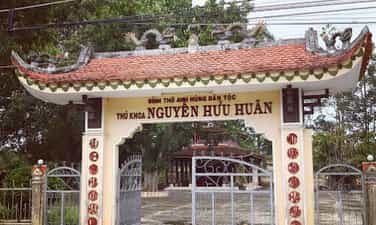
Thu Khoa Huan's tomb and temple
Thu Khoa Huan's real name is Nguyen Huu Huan. Born in 1830 in Tinh Ha village, Kien Hung district, Dinh Tuong province. Now it is My Tinh An commune, Cho Gao district, Tien Giang province. Son of Mr. Nguyen Huu Cam, a well-off farmer in the area. As a child, he was famous for being smart, assertive, very good at studying, and very diligent in his studies. In 1852 (during the reign of King Tu Duc), he took the exam in Gia Dinh and passed as valedictorian (top bachelor's degree). After that, he became a teacher or school director in Kien Hung district, Dinh Tuong province. When the French colonialists invaded our country (February 1859), he quit his teaching position, said goodbye to his family to join the resistance, linked up with patriotic scholars, recruited soldiers to stand up against the enemy, contrary to The Nguyen Dynasty's strategy of peace was essentially surrender. In April 1861, the French occupied My Tho. He and Thien Ho Duong launched an uprising, operating in Tan An and spreading to My Tho, greatly influencing the scholars of Cochinchina. At that time Thien Ho Duong was the Chief Administrator, he was the Deputy. At the end of 1861, seeing his influence, the French sent Ton Tho Tuong to persuade him to surrender but failed. In early 1862, he was ambushed, captured by the enemy and taken to Saigon. France assigned Mr. Do Huu Phuong (general governor of Phuong) to bribe the oligarch Viet Gian. He refused and cleverly sought to return to activities associated with Truong Dinh. In June 1863, the enemy discovered his base in Thuoc Nhieu (Cai Lay) so they surrounded and swept away. He and Thien Ho Duong escaped to An Giang to build Bay Nui base. Based on the Nham Tuat treaty, they sent an ultimatum forcing the An Giang province officials to hand over Thu Khoa Huan and Thien Ho Duong. Hearing the news, Thien Ho Duong escaped and then moved his base to Dong Thap Muoi while Thu Khoa Huan was captured and handed over to France. They accused him of opposing the state of Lang Sa (France) in opposing the treaty that the royal court had signed, sentenced him to 10 years of hard labor and was exiled to Réunion island. After 7 years in prison, they pardoned him and brought him under house arrest at Do Huu Phuong's house (Governor Phuong). At the same time, he was appointed as a teacher to teach students at Cho Lon in the hope of attracting him to their side. He took advantage of the teaching conditions to contact patriotic scholars and the Truong Phat Overseas Chinese Association to buy weapons. preparing for an uprising. While preparations for the uprising were in full swing, the French enemy, thanks to spies, captured the armed boat of Truong Phat's group. The uprising plan was broken because there were no weapons. Faced with that situation, he ordered the army to withdraw and return to My Tho to meet with Au Duong Lan to carry out the uprising. The operational area runs from Cai Lay to My Quy (Sa Dec). The center in Ben Tranh area has resonated throughout Cochinchina. To deal with the enemy, the governor and landowner Tran Ba Loc from Vinh Long to My Tho sent troops to suppress. In 1875, during a battle with an unfavorable enemy, he and his entourage, General Huong, sneaked back to Gao market with the intention of hitchhiking on a trading boat to Binh Thuan for help. But General Huong was bribed by Tran Ba Loc to lead troops to arrest Nguyen Huu Huan at Gao market on May 15, 1875, and take him into custody in My Tho. After 4 days of detention in My Tho, all his tactics to persuade him failed, and the French enemy sentenced him to death. On May 19, 1875, they sent a ship to transport him along the Bao Dinh river to his hometown of My Tinh An for execution (at 12 noon). He was 45 years old that year. On June 15, 1987, the Thu Khoa Huan Tomb relic was recognized by the Ministry of Culture and Information as a national historical relic. Source: Department of Culture, Sports and Tourism of Tien Giang Province
Dong Thap
9717 view
Rating : National monument
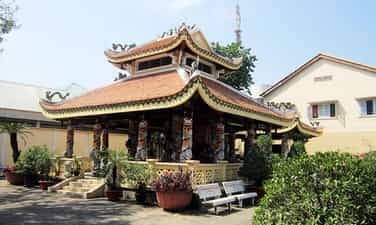
Tomb of Tu Kiet
Tomb of Tu Kiet is the name of the tomb and temple of four heroes who fought against the French in the years 1868 - 1870, including: Nguyen Thanh Long (Nam Long); Tran Cong Than (self-styled Phuong); Truong Van Rong and Ngo Tan Duoc (Germany) led the people and insurgent army of Cai Lay - Cai Be to stand up against the French invasion in the last decades of the 19th century. The mausoleum is located on April 30 Street, Cai Lay Town, Cai Lay District, Tien Giang. After the Four Men sacrificed, people built a tomb and temple in Cai Lay Town and to show respect for the people called Tomb of Tu Kiet. According to folk tradition, the four men were all famous for their courage, strategy, and superior martial arts. Having a passionate patriotism, when the French invaded Dinh Tuong province (1861), the four men joined the insurgent force led by Thien Ho Duong. Along with other insurgents, the four of them participated in many fierce battles in the areas of Ba Giong, Cho Gao, My Tho... during the fighting, the four of them achieved many resounding victories. In 1868, when Thien Ho Duong's uprising failed, the four men returned to Cai Lay to gather soldiers, choosing the Cai Be - Cai Lay area as the area to continue fighting against the French. The most glorious victory of Tu Kiet's army was the attack on My Tho citadel and the destruction of Cai Lay garrison. After two years of operations causing a lot of damage to the enemy, Tu Kiet's uprising had to fail under the siege and total suppression of the French expeditionary force. The four men were arrested. They lured them with glory and wealth for many days but failed. On February 14, 1871 (December 25, Canh Ngo year), the enemy took the Four men to the execution ground to be beheaded. More brutally, they also beheaded the four men at Cai Lay market, in order to threaten the spirit of the people. Then punch it at the river wharf next to the market. Admired by the lives and heroic and indomitable fighting example of the four men, the people of Cai Lay built an earthen tomb, surrounded by a wooden fence and solemn incense smoke. In nearby My Trang village, Mr. Nhieu, a student of Dang Van Nguu, built a shrine in front of his house right in the area where the four men were beheaded. The temple was roofed with yin and yang tiles and to blind the colonial government, people called it Ong Pagoda (because in front there was an altar to Quan Cong symbolizing loyalty), and at the back was a tablet engraved with the four words Four Gods. The soul, painted with bright red and gold, worships the Four Noble Phantasms. The storm in the year of the Dragon (1904) caused the temple to collapse. Mr. Nhieu moved the temple to Thanh Son village (formerly in Thanh Hoa commune, now Cai Lay town). Currently, the temple is located in Quarter 1, Cai Lay town, more than a hundred meters from Tu Kiet's Tomb. In 1967, Cai Lay people restored the temple and the Four Ong's tomb on a larger scale, with a shrine inside and a guest house outside. In 1999, the mausoleum of the four men was restored on a large scale by Tien Giang province, looking very spacious and ancient as it is today. Every year on the 25th day of the twelfth lunar month, Cai Lay people gather here in large numbers to sweep the graves and hold a very solemn death anniversary, respectfully remembering the Four Men who sacrificed themselves for the country and killed the enemy, setting a shining example. for posterity. On September 13, 1999, the Tomb of Tu Kiet relic was recognized by the Ministry of Culture and Information as a national relic. Source: Department of Culture, Sports and Tourism of Tien Giang Province
Dong Thap
7699 view
Rating : National monument
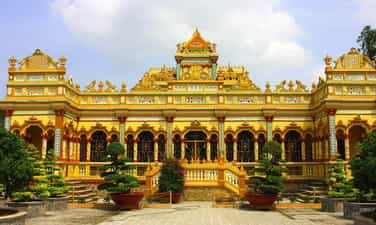
Vinh Trang Pagoda
Vinh Trang Pagoda is located in My An hamlet, My Phong commune, My Tho city, Tien Giang province. Vinh Trang Pagoda was built in the early 1990s and renovated in 1849 in the form of the Chinese character "Quoc", including 4 rooms: front hall, main hall, ancestral house, and back house in succession. The pagoda has a combination of Asian and European architectural style, the main hall represents a stupa, the two wings have spires, so the pagoda resembles 5 towers, symbolizing the five elements (metal, wood, water, fire, earth) according to the Buddhist philosophy. Eastern concept, shaped like an Angkor temple in Cambodia. The unique feature of the pagoda is the art of assembling pieces of porcelain to create harmonious art paintings, illustrating Buddhist stories at the two Tam Quan gates. The structure inside the pagoda has 178 columns, 2 quiet courtyards and 5 pagoda layers. The pagoda has 7 main sets of blue panels (and many additional blue panels) that are gilded with gold and carved with images of the Eight Immortals riding animals, the Sun God and the Moon God, elaborately carved by local artisans around 1907-1908. In the pagoda, there are about 60 precious statues made of bronze, wood and terracotta, plated with brilliant gold. The oldest set of statues at Vinh Trang Pagoda is the ancient Tam Ton set (Amitabha, Guanyin, The Chi, 93cm high) made of bronze as big as a real person. The Jade Emperor statue is in the same style as the statues of Gia Lam and Bodhisattva at Buu Lam Pagoda, also made of bronze as big as a real person. Different from past practice, the Jade Emperor here does not have Nam Tao or Bac Dau holding the book of life and death at the head of both sides, but instead there are Mr. Good and Mr. Evil. On both sides of the main hall wall is the altar of the Ten Palaces of Minh Vuong Bodhisattva. In particular, the most outstanding and most artistically valuable is the one-of-a-kind set of statues of the Eighteen Arhats carved from jackfruit wood from the Mekong Delta by artisans in 1907. This is a set of statues. Carved in a folk-inspired pattern, it is very lively, flexible and liberal. Each Arhat rides on the back of a fierce beast; holding his own treasure in his hand symbolizes the senses that Buddhist teachings call the six senses: eyes, ears, nose, tongue, body and mind; in three times: past, present and future. In the pagoda there is a 1.2m high Dai Hong Chung; weighs about 150kg and was cast in bronze in mid-May 1854; The bell body is engraved with the word "Vinh Truong Tu". The sound of the bell adds to the silence and solitude of the temple. Also here, we will encounter Renaissance-style patterns, Roman-style arches, French iron wool, Japanese ceramic tiles,... Chinese characters are written in the ancient Trien script style, while the national language is written in in Gothic style. In front of the pagoda is Vinh Trang park, with an Amitabha Buddha statue over 24m high (pedestal 6m, statue 18m) standing tall in a spacious garden with many beautiful ornamental trees built by sculptors Thuy Lam and Chau Viet Thanh. Construction started on the full moon day of the first lunar month and was completed on the 8th day of the last lunar month in the year of the Pig (2007). On the left of the main hall is the statue of Maitreya Buddha sitting in the middle of the park. The statue is 16m high and weighs about 250 tons; The ground below the Buddha statue is arranged on one floor and the ground floor, the space is spacious; The lights and decorative lights are designed in a very Zen way... made by sculptor Thuy Lam. Behind the pagoda is the 35m long statue of Sakyamuni Buddha entering nirvana. Vinh Trang Pagoda not only has religious significance and architectural - artistic value, the pagoda is also a place to hide many patriots; providing logistics for the revolutionary movement, contributing to the cause of national liberation. Vinh Trang Pagoda was ranked as a national historical-cultural relic in 1984. Source: Department of Culture, Sports and Tourism of Tien Giang Province
Dong Thap
8786 view
Rating : National monument
Go Thanh archaeological site
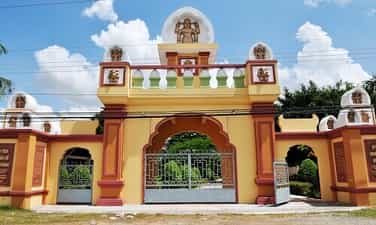
Go Thanh relic belongs to Oc Eo culture, located in Tan Thanh hamlet, Tan Thuan Binh commune, Cho Gao district, Tien Giang province. The name Go Thanh appeared when the first Vietnamese people who came to explore this land saw many bricks on the mound, thinking it was a vestige of an ancient citadel, so they named it Go Thanh, with the purpose of marking a location in residential area. In 1941, Malleret, a French archaeologist, discovered this place. In 1979, some Tien Giang Museum officials came here to survey. In July 1987, a new archaeological investigation was officially conducted and came to the conclusion: Go Thanh archaeological site belongs to the Oc Eo culture. In Khmer language, it means "bright area", "bright spot" is the ancient name of the Ba The - Sap mountain region (now Vong The commune, Thoai Son district, An Giang province). In 1941, after Malleret discovered this place, he collected some artifacts and published them in France. This culture was named after the place where it was discovered, so it is called "Oc Eo Culture". During the years 1988 - 1989, Tien Giang Museum combined with the Archeology Center to conduct two seasons of excavation and survey at this relic. Archaeologists have analyzed a number of samples here using the C14 (Carbon - 14) method, concluding that the Go Thanh archaeological site dates from the 4th to 8th centuries AD. This is a special relic area because it is still preserved quite intact and rich with 3 different types of relics: residential relics, architectural relics and burial relics. Especially the architectural relics with many temples and towers next to each other of different scales, very majestic, although only the foundation remains. Through ancient bibliographies, it is shown that Oc Eo culture is the culture of the Funan kingdom. At that time, Funan was one of the most powerful kingdoms in Southeast Asia, with large trading ports and goods exchange with many countries around the world. Funan society consisted mainly of classes: farmers, merchants, clans and clergy. In particular, this place has many diverse artifacts, representing the civilization of an ancient country, not only found in the East and Southwest of Vietnam but stretching to eastern Cambodia and part of the coast. Thai customs. After excavations, restoration and embellishment of the monument, archaeologists have found: In the middle of the temples and towers are square well-shaped worship holes with many different designs, with depths from 1.5 to 3 meters. At the bottom of the pit, there are occasionally square or circular pieces of gold cut in the shape of lotus petals, engraved with images of animals, mainly elephants, a little ash, square wooden bars with sides of about 40 cm stacked on top of each other in a pattern. square, alternating layers of yellow sand and pebbles. The tower's foundation is solidly built with layers of bricks of diverse sizes. Archaeologists have discovered 271 relics made of gold, bronze, stone, and terracotta that bear basic characteristics of the Oc Eo culture. Inside the house displaying artifacts, there is a statue of Vishnu in its original form, a statue of a goddess and a statue of a male god, all of which only have their bodies remaining; A small piece of stone with Sanskrit inscriptions (ancient Sanskrit) with very few strokes remaining; There are both male and female fertility models, symbolizing the origin of human development; 2 blue purple and clear white gemstones. In addition, there are many pieces of vase spouts, many rough and smooth ceramics colored red or brown with decorative patterns, and some ceramic leaves. The Ministry of Culture, Sports and Tourism recognized Go Thanh archaeological site as a "National Historical and Cultural Site" on December 12, 1994. Source: Department of Culture, Sports and Tourism of Tien Giang Province
Dong Thap
6667 view
Rating : National monument
Dong Thanh Central Communal House
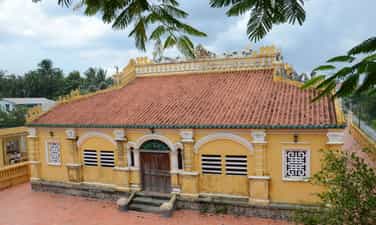
Dong Thanh communal house is one of the communal houses with a long history and large construction scale in the South. With unique architecture, in 2009 Dong Thanh communal house was recognized as a National Monument. Dong Thanh communal house relic is located in Loi An hamlet, Dong Thanh commune, Tien Giang province. The communal house was built at the end of the 19th century and is a testament to the process of reclaiming land and establishing hamlets by Go Cong area residents. According to documents from the Tien Giang Museum, when Dong Thanh communal house was first built, it was small-scale, made of thatch and bamboo leaves; Later, because the lives of the people in the area were better off thanks to fertile land and continuous good harvests, they contributed money to rebuild the wooden communal house with tiled roof, including martial arts, main hall and guest house, lasting from It was completed from 1900 to 1914. During the period 1960 - 1963, the Dong Khoi movement in the South was very strong, Dong Thanh communal house was also the place where the Dong Khoi movement took place. However, during this movement, Dong Thanh communal house had its main hall, wooden walls and tiled roof burned. In 1970, local people and the Temple Association at that time donated money to rebuild the main hall as it is today. According to the elders in the area, Dong Thanh communal house worships Dai Can four Nuong kings (worships four gods protecting seafarers) and worships Than Nong. In addition, people also worship those who have a lot of merit in the village and commune. Every time to worship at the communal house on the 16th, 17th, 17th and 16th days of the 11th lunar month, people come to worship crowdedly and bustlingly. In terms of artistic and architectural value, Dong Thanh communal house has gone through more than a century of many devastating wars and natural disasters, but still exists and leaves many marks on the architecture of Southern pagodas and temples. . This is one of the communal houses with a long history and large construction scale in the South. The communal house has a construction area of 787 m2, following the Tam-shaped architectural style, including: Vo ca (where boi singing is performed on the occasion of Ky Yen), chanh tam (place to worship gods) and a guest house (where villagers come to discuss business). connected. The unique features of this communal house are the art of carving, decorative patterns, embossed paintings on the walls and ceramic statues decorating both inside and outside the communal house. In particular, the elaborately carved patterns and decorative motifs at the communal house are symbolized by the four sacred animals, the four precious animals, the eight immortals, the fish turning into dragons, fruits, and local products; The symbols imply wealth, prosperity, hope for abundant happiness, good rain, peaceful wind... Among them, the martial arts house is a fairly large wooden structure, structured in the style of a beam house. . On the eel on the edge of the martial arts roof, there is a dragon decorated with pieces of porcelain and ceramic put together. Source: Electronic information portal of Tien Giang province
Dong Thap
6437 view
Rating : National monument