Relic point Vietnam
Việt Nam
Ratanaransi Pagoda (Lang Cat Pagoda)
Lang Cat Pagoda is located at 325 Ngo Quyen Street, Quarter 1, Vinh Lac Ward, Rach Gia Town, Kien Giang. This is a temple belonging to the Theravada sect of the Khmer people. Lang Cat Pagoda had a total of 31 generations of abbots and many different names. The pagoda was built in 1412, initially named Angkor Chum because the abbot was Cambodian. After that, the pagoda was renamed Lang Cat pagoda, because it is located on a large highland in the southeast of Rach Gia. In May 2009, Lang Cat pagoda, along with the Kien Giang Buddhist Association Provincial Executive Committee and the solidarity association of patriotic monks, organized the inauguration of the main hall. By 1997, the Management Board and Buddhists called for donations to contribute to the construction and by 2003, the foundation and foundations along with concrete columns were built. Lang Cat Pagoda has architecture bearing strong Khmer imprints. The main hall area of the pagoda is solemnly decorated, with an altar for a Buddha statue and a pearl relic brought by Venerable Ho Tong from India in 1957. The Buddha hall is solemnly decorated. The top floor is decorated with a statue of Sakyamuni Buddha attaining enlightenment, below are statues of Buddha holding a vase for alms and Buddha saving sentient beings. The pagoda has been recognized by the Ministry of Culture and Information as a national historical and cultural relic. Source: Kien Giang Province Buddhist Church
An Giang
7227 view
Rating : National monument

Vinh Hoa Temple
Vinh Hoa communal house is a historical and cultural heritage that has existed for nearly 300 years, is the oldest communal house in Kien Giang province, and is a place of pure cultural activities of the people of Rach Gia area since people came here to reclaim land. establish a hamlet. Vinh Hoa Communal House, often called Vinh Hue Communal House, is located at 61 Nguyen Hung Son Street, Vinh Thanh Van Ward, Rach Gia City, Kien Giang Province. The communal house was built in the early 18th century with the first name of Hoi Dong Temple, a temple to worship Thanh Hoang Bon Canh, the God of the Middle Ages that people considered very inspiring. In 1883, the ancient temple of Hoi Council was rebuilt larger than the communal house. Vinh Hoa communal house is proud to have been conferred twice by the Hue court: during the reign of King Minh Mang (1832) and the reign of King Bao Dai (1934). In the history of resisting French invasion in the early 19th century, Vinh Hoa Communal House was the fighting point of national hero Nguyen Trung Truc after defeating Rach Gia garrison (June 16, 1868). During the pre-uprising period of 1932-1945, Vinh Hoa Communal House was the fulcrum of the Rach Gia people against oppression and exploitation, was one of the places where the first local branch of the Indochina Communist Party was established, and was the cradle secret revolutionary activities of the Communist Party branch, which is the red address to receive and spread Marxism - Leninism into Rach Gia - Ha Tien province. Through many historical changes, Vinh Hoa Communal House has also been gradually renovated. The communal house has great value in both history and traditional cultural activities. It is a place to organize festivals and entertainment such as boi singing, lion dance, dragon dance... and is a unique artistic work of working people aiming to preserving the customs and practices of Vietnamese people during the period of historical and cultural development, marking the footsteps of Vietnamese people coming here to expand their territory. Vinh Hoa communal house was recognized as a national historical relic on September 5, 1989. Source: Kien Giang Tourism
An Giang
11257 view
Rating : National monument

Tam Bao Pagoda
Tam Bao Pagoda relic is located on Su Thien An Street, Rach Gia City, Kien Giang Province, Tam Bao Pagoda is recognized as a cultural historical relic by the Ministry of Culture and Information (now the Ministry of Culture, Sports and Tourism). national level in 1998. At first, Tam Bao Pagoda was built of wood and thatched with leaves. In 1917, monk Tri Thien rebuilt the temple. The development history of Sac Tu Tam Bao Pagoda is associated with the Dharma preaching career of monk Thich Tri Thien, whose name is Nguyen Van Dong, so the pagoda is called Ong Dong Pagoda. Since 1940, monk Tri Thien, monk Thien Chieu, and monk Thien An used Tam Bao Pagoda as a contact location and a place to hide homemade weapons, documents, and leaflets in preparation for the Cochinchina uprising. In June 1941, due to a tip-off, the French searched the pagoda, monk Tri Thien and monk Thien An were arrested by the French. Going to the Criminal Court, monk Tri Thien was sentenced to 5 years of exile in Con Dao, monk Thien An was sentenced to death. In Con Dao, in 1943, monk Tri Thien went on a hunger strike to protest the harsh prison regime and death. Legend has it that Tam Bao Pagoda was awarded the title "Sac Tu Tam Bao Pagoda" by King Gia Long. The ordination plate was said to have been lost during the period of repression by the French invaders in the 30s and 40s of the 20th century. Tam Bao Pagoda has a unique overall architecture, neat layout, harmonious combination of brick, wood, and stone materials. Quiet and solemn space. The pagoda has three floors of tiled roofs, covered with tube tiles. Rows of large black wooden pillars with bulging pillars carved into an octagonal shape look solid. The main hall is divided into three compartments, each compartment has an altar. The wooden panels are embossed, lacquered and gilded with artistic images of dragons, phoenixes, flowers, and birds, creating a sacred impression on viewers. Tam Bao Pagoda has many beautiful statues and demonstrates a high level of sculpting techniques. Today, the pagoda is visited by many people and tourists to worship and admire the scenery every time they have the opportunity to come to Rach Gia City. Source: Kien Giang Online Newspaper
An Giang
7702 view
Rating : National monument

Dinh Than Nguyen Trung Truc
Nguyen Trung Truc Communal House or Nguyen Trung Truc Temple is located in the west of Rach Gia city center, is the earliest and largest communal house worshiping Nguyen Trung Truc among the nine temples worshiping him in Kien Giang province, currently Located at 14 Nguyen Cong Tru Street, Vinh Thanh Ward, Rach Gia City, Kien Giang Province. Nguyen Trung Truc's real name is Nguyen Van Lich, born in 1838, in Binh Nhat, Cuu An district, Tan An district (now in Binh Duc commune, Ben Luc district, Long An province). Growing up in a situation where his country was invaded by the French colonialists, he joined and led the insurgent army against the French. He was captured by the French colonialists and executed by them in Rach Gia, Kien Giang province, when he was only 30 years old. On December 10, 1861, Nguyen Trung Truc and his insurgents achieved a resounding victory, burning the French enemy ship Espérance on Nhat Tao beach, destroying many enemies. After the Nhat Tao victory, Nguyen Trung Truc was awarded the title of military officer by the court, a martial officer ranked among the fourth rank. At the end of June 1867, the French colonialists occupied Vinh Long, followed by An Giang and Ha Tien provinces. At this time, Nguyen Trung Truc and a number of insurgents returned to Hon Chong to build a base, preparing forces to continue attacking the enemy. After Nguyen Trung Truc's resounding victories, the French invaders and their henchmen frantically searched for him, offering a high reward to anyone who could capture or kill him. More cruelly, they arrested his mother to pressure him to surrender; At the same time, they strengthened their forces to suppress the insurgents. Unable to surrender to the invading enemy, Nguyen Trung Truc and the insurgents withdrew to Phu Quoc island to preserve their forces and build a base to continue fighting against the French. On September 19, 1868, the French enemy sent more than 100 Ma Ta soldiers to Phu Quoc to attack Ham Ninh; Then they added reinforcements to attack Duong Dong. They surrounded, terrorized, and strictly controlled the people on the island in order to isolate and destroy the insurgents. Faced with the sight of his compatriots being oppressed, interrogated, the insurgents' weapons exhausted, and the enemy's position becoming stronger, Nguyen Trung Truc decided to sacrifice himself to preserve the forces of the insurgents and the lives of his compatriots. Admiring and respecting the national hero, after Nguyen Trung Truc was executed by his enemies, the people set up a secret tablet to worship him at Lang Ca Ong. Initially, this place was just a small wooden temple with a thatched roof; After many repairs, Nguyen Trung Truc Temple has become more and more spacious. In 1987, the communal house and mausoleum of national hero Nguyen Trung Truc were recognized by the Ministry of Culture as a national historical and cultural relic. Nguyen Trung Truc Communal House is located on the bank of the Kien River facing the sea, in front there is a large gate column with the name of the throne written on it. Currently, not only in Rach Gia city, but many places in Kien Giang province also have dozens of temples worshiping Nguyen Trung Truc, such as temples in Hon Dat district, temples in Chau Thanh district, temples in Kien Luong district. , temple in Phu Quoc district... Some provinces such as Long An, An Giang, Ca Mau, Binh Dinh... all have temples to national hero Nguyen Trung Truc. Every year, on the 26th, 27th, 28th of the 8th lunar month, people in the province and localities throughout the country gather in Rach Gia city to commemorate National Hero Nguyen Trung Truc. Source: Electronic information portal of Kien Giang Department of Culture and Sports
An Giang
11240 view
Rating : National monument

Ba Le Pagoda
Phuoc Hoi Pagoda is affectionately called Ba Le Pagoda by local people, located in Hoi An commune, Cho Moi district, An Giang province. The reason for this name is because the temple was built on the land of Mrs. Le, a Chinese-Vietnamese living in the locality. Ba Le Pagoda follows the Mahayana sect, built at the end of 1897, with simple bamboo and leaves as a place of worship for local people. Phuoc Hoi Pagoda worships Amitabha Buddha, Shakyamuni Buddha, Maitreya Buddha, Avalokiteśvara Bodhisattva, Mahasthamaprapta Bodhisattva, Ksitigarbha Bodhisattva... Not only worshiping Buddha, the main hall of Ba Le Pagoda also Worshiping the Emperor: Jade Emperor, Nam Tao, Bac Dau, Four Heavenly Kings... In addition, the pagoda also has an area to worship those who have contributed and sacrificed in the war to protect the country. Not only is it a place of worship, Phuoc Hoi Pagoda is also a "red address", marking many local historical events. In particular, right from the first years of its establishment, the pagoda was a gathering place for people to fight against the enemy. During the two resistance wars against the French colonialists and the American imperialists by the army and people of An Giang province, Phuoc Hoi Pagoda was one of the solid revolutionary bases. From 1920 to 1965, when monk Thich Quang Dat became the abbot at the pagoda, he made great contributions to revolutionary work and activities such as supplying food, weapons, ammunition and housing many revolutionary cadres. provincial and district network. During the years 1945-1946, Ba Le Pagoda was the Office base of the Resistance Administrative Committee; is a place where young people organize military training against the French. This is also a facility for manufacturing rudimentary weapons and printing leaflets and documents... Ba Le Pagoda is a place where many generations of patriotic people have been trained. Many local officials have grown up and actively contributed to the fight for independence, national defense and national construction. In particular, many officials from the temple have contributed blood and even their lives to the Fatherland. Prominent among them is Ms. Huynh Thi Huong, a martyr who was awarded the title of Hero of the People's Armed Forces. Ms. Huynh Thi Huong's heroic example of fighting and sacrificing has brightened the glorious tradition of her homeland. At the same time, it brightens the resilient and indomitable fighting spirit of the An Giang people. Today, in her hometown of Hoi An, there is a spacious school named Huynh Thi Huong, leaving a mark for generations of students to remember the indomitable example of the heroic female guerrilla. On December 12, 1986, the Ministry of Culture recognized Ba Le Pagoda (Phuoc Hoi Tu) as a national historical relic. In particular, every year, on the occasion of the anniversary of Southern Liberation and national unification, the pagoda welcomes many officers and soldiers to offer incense and sincerely worship the heroic spirits of the martyrs. in the temple. Thereby, contributing to educating patriotic and revolutionary traditions in the heroic land. Source: An Giang Newspaper online
An Giang
7846 view
Rating : National monument

Giong Thanh Pagoda
Giong Thanh Pagoda, also known as Long Hung Tu, is located in Long Son commune, Phu Tan district, An Giang province. The pagoda was first built by monk Tran Minh Ly in 1875 using simple bamboo materials. In 1927, Venerable Chanh Huong (1879 - 1947), a native of Long Son commune, realized that the Zen temple was increasingly crowded with followers and the pagoda was too old and narrow, so he asked the French authorities to let him go. Donate to rebuild the Buddha temple. In 1970, Venerable Chon Nhu (1925 - 1972) restored the pagoda according to Indian-style architecture. And this is the largest restoration, and exists to this day. Regarding the name Giong Thanh Pagoda, according to some documents, it comes from the place where the pagoda was built on the ground of the Nguyen Dynasty citadel moat. From the outside, the pagoda has an Indian architectural appearance with a two-storey funnel-shaped tower roof, decorated with many elegant patterns, but overall, Giong Thanh Pagoda is a harmonious architectural block in the Asian-style. The structure is built in the shape of the letter "two joys", consisting of 3 compartments, the roof is covered with hooked tiles, and on the main hall column there is a drawing of a dragon. In the main hall, there are many ancient statues such as the statue of Amitabha Buddha, the statue of the Thap Dien Minh Vuong... The two large tomb towers at the pagoda are the towers of Venerable Dat Dien (38th generation) and Venerable Chon Nhu (40th generation). . In addition to its majestic appearance, Giong Thanh Pagoda is also known by many people as the red address of the patriotic movement against foreign invaders. Here in the early 20s of the 20th century, Phan Xich Long's Golden Rafter and Green Rafter organization met to attract patriots to fight against the French colonialists, opening a series of patriotic activities. This is also the place where Deputy Nguyen Sinh Sac - President Ho Chi Minh's father - spread true patriotism to the people (1928 - 1929). During the heroic anti-American years, Giong Thanh Pagoda continued to be the base of the Chau Doc Provincial Party Committee, Tan Chau District Party Committee and the communication point of Area 8, Central Department of the South. In particular, this place used to be a safe haven for many high-ranking leaders of the Party and State during the years of resistance to drive the Americans out, beat the puppets into submission such as: Nguyen Van Linh, Vo Van Kiet... Every year on the full moon days of January, July, and October (lunar calendar), many people from all over come to visit and worship at the pagoda. Besides being a place to preserve cultural values, Giong Thanh Pagoda relics are also associated with historical marks, when the pagoda was once a refuge for many revolutionary soldiers and a place to organize major activities. rule and fight against the French colonialists. Thanks to great contributions, on December 12, 1986, Giong Thanh Pagoda relics were recognized by the Ministry of Culture, Sports and Tourism as one of the national historical relics. Source: An Giang Tourism
An Giang
6827 view
Rating : National monument

Hoa Thanh Pagoda (Jackfruit Tree Pagoda)
Hoa Thanh Pagoda or Hoa Thanh Co Tu, commonly known as Cay Mit Pagoda, is located in Nhon Hung commune, Tinh Bien district, An Giang province. Hoa Thanh Pagoda was built by the people of Nhon Hung village in 1847, initially very simple with mixed trees, leaf walls, and thatched roof. In 1913, the pagoda burned down, people contributed to rebuilding the pagoda with wood, plank walls, and yin-yang tiled roof. In 1925, monk Huynh Hong Diep rebuilt the spacious pagoda as it is today. The total construction area of the pagoda is about 500m2, the architecture includes 4 sets of roofs, round wooden columns, and walls built of lime mortar mixed with egg stone. Hoa Thanh Pagoda was built according to a unified architectural layout. There are two main roofs in the front and back, and two side roofs, built on a 0.5 m high foundation, the roofs spread low with the tips at the four corners curving up. In front of the pagoda is Lien Tri pond built in 2009. On the pond there is a path leading to a very beautiful statue of Guan Yin Buddha riding a dragon. On the left is the Maitreya Buddha temple, on the right side of the temple are two stupas. In the main hall, the pagoda also preserves many ancient statues with unique artistic value. In front of Hoa Thanh Pagoda, there is a memorial stele with the image of the Vietnamese national emblem. In the middle of the national emblem is a board recording the date and year when Mr. Nguyen Sinh Sac came to the pagoda. The outstanding art of the pagoda is the worship statues, most of which are made of jackfruit wood, skillfully carved by local artisans into 19 types of statues, ranging from 0.4m to 1.4m high. According to some elders in the village, this place is full of dense forest, overgrown with trees, and has a lot of jackfruit wood. Seeing this, the monks used jackfruit wood to build pagodas and carve statues for worship. In 1913, while the pagoda was on fire, people near the pagoda and monks were able to carry the statues out of the pagoda. Therefore, the pagoda has kept the precious wooden statues to this day. As for the Jade Emperor statue, it was burned and there are still traces left behind. The Buddha statues are shown with quite accurate shaping techniques according to each model, their appearance is dignified, and their clothes are neat. From the details of the hand holding the treasure, the head wearing the crown, the figure standing on the platform or sitting on the animal, the throne or the lotus... all are sketched very standardly, with sharp lines, with very bright gilded vermilion colors. brilliant. In addition to its architectural and artistic value, Hoa Thanh Pagoda is also where Deputy Chairman Nguyen Sinh Sac (father of President Ho Chi Minh) once lived. After resigning, to avoid being tracked by secret police and the French colonial government, Mr. Sac went through many provinces in the South, including An Giang. From 1921 to 1923, he often went to Cay Mit Pagoda (the popular name of Hoa Thanh Pagoda at that time), at that time the pagoda was headed by monk Huynh Hong Diep, who was also a patriotic scholar. Hoa Thanh was used as a meeting and communication place between Mr. Pho Bang and scholars everywhere. And also from Hoa Thanh Pagoda, the spirit of patriotism and non-cooperation with the French colonialists and their lackey government had a great influence on the people in the region. During the resistance wars against the Americans to save the country and protect the southwestern border of the Fatherland, Hoa Thanh Pagoda was a solid base for the revolution and the soldiers. The temple grounds have secret vaults to hide officials and organizing activities. Therefore, the people of Bay Nui area consider Cay Mit Pagoda - Hoa Thanh as a cultural work and a relic marking many glorious historical events in fighting, protecting and building the homeland. On August 4, 1992, the Ministry of Culture, Sports and Tourism recognized Hoa Thanh Co Tu as a national historical architectural and artistic relic. Source: An Giang Tourism
An Giang
6649 view
Rating : Updating

Ong Bac Pagoda
Ong Bac Pagoda, also known as Bac De Temple - the first assembly hall of the Chinese people in An Giang is located on Pham Hong Thai street, on the bank of Long Xuyen river, in My Long ward, Long Xuyen city, An Giang province. Bac De Temple is considered a worship facility for Chinese people who migrated from Guangdong province (China) to make a living in An Giang. Together they built the Assembly Hall, essentially an administrative office to serve as a meeting place for contacting fellow countrymen, but often added statues of the gods Bac De, Thien Hau, Ngoc Hoang, and Quan Cong to worship, so the Vietnamese called it a pagoda. . Like Ong Bac Pagoda, which means worshiping the Northern Emperor. This Assembly Hall was built over 100 years ago, when this land was still called Dong Xuyen, then belonged to My Phuoc village, Tay Xuyen district, Tuy Kien district, An Giang province during the Nguyen Dynasty. According to the elders and based on inscriptions recounting the history of the pagoda, the pagoda was initially quite simple. In the year of Giap Ngo (1887), Mr. Quang Thanh Loi and Hoa Mau Xuong, two wealthy Chinese people in the area, stood up to mobilize fellow countrymen and people to believe, contribute money, and start the second repair. After 4 years of construction, in the year of Mau Tuat (1891), the pagoda was completed and became a beautiful and typical artistic architectural work of Long Xuyen city. This is a typical Cantonese-style building, dark yellow combined with red and brown, with curving patterns on the roof tiles. The pagoda was recognized as a national historical and cultural relic in June 1987. Connected to the lobby and the Bac De altar are two parallel roads. The front hall - Thien Tinh yard (also known as the skylight) is considered a feng shui exchange area, on both sides are two circular doors, through the East and West corridors. The roof of the pagoda is covered with green glazed pipe tiles, on the edge of the roof are carved images of the Eight Immortals, elephants, dragons, phoenixes, fish... along with ancient, beautiful reliefs and patterns that represent the art of the Nguyen dynasty mixed with architecture. Chinese art. The main person worshiped in the main hall is the Bac De, the sitting general looks very majestic and majestic, his head is wearing the king's royal crown, his hands are holding seals, his hands are holding swords, his feet are stepping on snakes, his feet are stepping on spiritual snakes... Before the ceremony, Quan is worshiped. The temple and altar to worship Thien Hau have a pair of dragon pillars, above the altar are the Eight Immortals... In addition, Shakyamuni Buddha, Ksitigarbha Bodhisattva, Jade Emperor God... are also worshiped here. All combine into a cultural identity of the Chinese people, which has long been integrated into Vietnamese culture. In general, the interior decoration colors of Bac De Temple are very bright but harmonious; The patterns, tureens, and feng shui are all expressed with very unique and sophisticated lines of sculpture and carving. Although it was built more than a century ago and has undergone many repairs, the Bac De Temple relic still retains its original state. This place still preserves many precious relics over 100 years old, such as: Three inscriptions recording the merits of those who contributed to the construction and repair of the Assembly Hall; bronze bells (Dai Hong Chung bell), iron top, three altars (opening bell); The sea of sculptures of the Three Realms with pure architectural designs of the Chinese people. In particular, the bronze bell is still ringing every day. Source: An Giang Tourism
An Giang
7013 view
Rating : National monument

Steel Wire Column Historical Site
Steel wire column relic in Long Thuan hamlet, Long Dien A commune, Cho Moi district, An Giang province. The steel wire pole was built by the French colonialists at the end of the 19th century, as a communication system connecting the two communes of Long Dien and Tan My, located next to a branch of the Tien River. The column body is made from 4 steel pillars, linked together to form a tower with a square top, with a total height of more than 30m, very solid. Each (L) shaped steel leg is irregularly connected, about 1.5m apart. The column has a surrounding stone pedestal, located in the middle of the main gate to the relic site. The relic area has an area of about 3,000 square meters. In addition to the large campus for celebrating anniversaries or events, inside there is also a traditional house, preserving objects and images of local leaders and people. On February 3, 1930, the Communist Party of Vietnam was born on the basis of unifying three Party organizations in our country, under the chairmanship of comrade Nguyen Ai Quoc (Ho Chi Minh). The Party was born as a halo illuminating the path for the Vietnamese revolution, campaigning to attract the masses to become enlightened and follow the Party's revolutionary path. In An Giang, the province has chosen Cho Moi as an organizational development point. From here, the first Party cell was also established in Long Dien commune in April 1930. Initially there were 3 comrades: Luu Kim Phong, Bui Trung Pham and Doan Thanh Thuy. In order to strongly develop the grassroots, the comrades have gone deeply into mobilizing the masses and craftsmen. To bypass the henchmen and colonialists and take advantage of the football movement at My Long Stadium (Long Dien commune), the comrades secretly passed it on to each other to widely propagate the Communist Party. Congratulations on the formation of the first Party cell of An Giang province, a Party flag was hung on top of a steel wire pole, but was soon taken down by the French colonialists. A few days later, the second Party flag was hung up in the dead of night. The next morning, the red flag "hammer and sickle" fluttered like "Aura on the Tien River", making the enemy angry and afraid, and the people extremely excited. From here, the Steel Wire Pole is the location where our Party gathered the masses to protest twice. Many Party cells were also established and led the people to fight for many victories. The relic site still preserves a number of traditional household objects. With milestones in the movement for independence, the Steel Wire Pole became a typical revolutionary historical site and was decided to recognize by the Ministry of Culture, Sports and Tourism as a historical-cultural relic. national level on January 9, 1990. Source: An Giang Newspaper online
An Giang
10546 view
Rating : National monument
Temple to worship Officer Tran Van Thanh
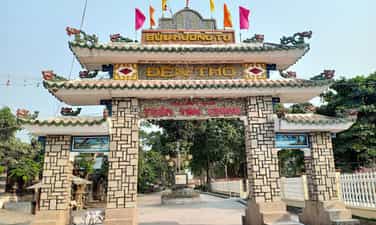
Temple worshiping Officer Tran Van Thanh (Thanh My Tay commune, Chau Phu district, An Giang province). This is the place associated with the life and heroic struggle of Commander Tran Van Thanh and the Gia Nghi insurgents in the Lang Linh - Bay Tho uprising against the French colonialists. Manager Tran Van Thanh was born into a well-off middle-class farming family in Binh Thanh Dong commune (Phu Tan district). When he grew up, he went to study Confucianism. He studied little but knew a lot. Later, his father took him home to teach him martial arts, first to protect himself and then to help honest people. From 1840, Mr. Tran Van Thanh joined the army, and in 1845 he became Chief Manager, so he was also called Manager Thanh. In 1867, France occupied Chau Doc citadel (An Giang province). Not subduing the enemy, he pulled the militia to Bay Tha to build a base, coordinating with Nguyen Trung Truc's insurgent army to fight the French in the Long Xuyen and Rach Gia areas. After Nguyen Trung Truc was executed by the French (in 1868), Commander Tran Van Thanh gathered insurgents from all over the Western region to Lang Linh to build fortresses, forge knives and swords, and attack enemy posts... The French attacked Lang Linh - Bay Tho many times but did not achieve results. In early 1873, the French sent someone to bring a letter to bribe them, but Commander Tran Van Thanh firmly refused to submit. Unable to bribe him, the French mobilized soldiers from Long Xuyen, Can Tho, and Chau Doc to attack the Chau Phu area. From March 19 to 20, 1873, Commander Tran Van Thanh directly commanded the insurgent army to fight against the enemy and sacrificed heroically. People mourned and called him Duc Co Quan, and built a temple in Lang Linh. The temple worshiping Officer Tran Van Thanh, also known as Buu Huong Tu or Duc Co Quan's Palace, was built in 1897, as a place to commemorate Officer Tran Van Thanh and the Gia Nghi insurgents who sacrificed their lives in the Lang Linh uprising - Bay Tha (1867-1873) was also the place where people and followers of the Buu Son Ky Huong religion gathered to patriotically fight against the French colonialists. In February 1913, on the death anniversary of Officer Tran Van Thanh and Gia Nghi insurgents, Mr. Tran Van Nhu organized a large ceremony, patriotic people around the area and descendants of insurgents attended in large numbers. The French colonialists were afraid, so they came to surround and burn the temple to destroy any trace of Admin Tran Van Thanh. In 1938, Mr. Nguyen Van Tinh, a follower of Buu Son Ky Huong, rebuilt the temple at the old foundation, roofing it with tiles, building brick walls, wooden columns, and a spacious and spacious tiled floor. In 1947, revolutionary forces from the temple of Quan Co Tran Van Thanh destroyed the French colonial post in the commune. In retaliation, the French colonialists terrorized and burned the temple again, leaving only 4 pillars in the main hall. In 1952, people around the area contributed money to rebuild the temple of Quan Co Tran Van Thanh, as spacious as it is today. The temple was built in an ancient architectural style, in the shape of the letter "three" including the main hall, east corridor and west corridor, roofed with large tube tiles, on the roof there is a statue of two dragons with pearl paintings, wooden pillars, brick walls, tiled floors. encaustic tiles. From 1955-1975, the temple was the commune's revolutionary base, a place to supply, communicate and house cadres working in the locality. On December 12, 1986, the temple of Quan Co Tran Van Thanh was recognized by the Ministry of Culture, Sports and Tourism as a national historical-cultural relic. Every year, on February 20, 21 and 22 (lunar calendar), local authorities and a large number of people solemnly organize death anniversary ceremonies according to traditional rituals. Source: An Giang Newspaper online
An Giang
6724 view
Rating : National monument