Relic point Vietnam
Việt Nam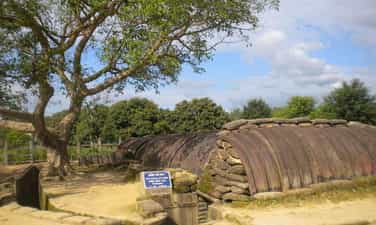
Command bunker of Dien Bien Phu stronghold group
Ham Do Castries (local people's name) full name is Dien Bien Phu stronghold group command post, also known as GoNo command post, located in Thanh Truong ward - Dien Bien Phu city - Dien Bien province. . During the Dien Bien Phu campaign, GoNo Command Post was located in the center of the stronghold group, 2m underground and in a lower position than the direction of our army's attack. This is the headquarters of a giant military group that France and the US are very proud to consider the strongest fortress ever in Indochina. GoNo command post is given priority to have solid and solid construction materials capable of resisting enemy firepower, in addition to being protected by all the most modern weapons and means of warfare at the time. then. The structure and arrangement of the basement are still kept intact with a length of 20m and a width of 8m divided into 4 compartments used for both work and accommodation. Surrounding the bunker is a barbed wire fence with alternating mines and 4 defensive tanks in 4 directions. In this basement, De Castries solemnly welcomed many high-ranking officials from England, France, America and dozens of writers and journalists from the Western journalism industry. It was also here that De Castries and his entire General Staff plotted to destroy our main army, but he also had to go crazy many times to deal with enemy attacks. Vietnam People's Army. At 3:00 p.m. on May 7, 1954, our campaign command ordered a general attack on the entire front to destroy the entire group of Dien Bien Phu strongholds. After destroying key strongholds around the central division, our troops crossed Muong Thanh bridge and headed straight to Gono Command. At 5:30 p.m., comrade Ta Quoc Luat, commander of company 360, regiment 209, regiment 312, and 2 assault soldiers captured General De Castries and the entire French command, holding the flag "Determined battle, Quyet". Victory" flew high above the tunnel roof in the middle of the historic summer afternoon of May, signaling the day of complete victory for our army and people. Today, the Ham Do Castries relic along with other relics in the Dien Bien Phu historical relic complex have been invested in by the Party and State to restore and renovate to serve domestic and foreign visitors. Part of promoting the value of the Dien Bien Phu historical victory relic site and also to propagate and educate the heroic Dien Bien Phu tradition. Source: Department of Culture, Sports and Tourism of Dien Bien province
Dien Bien
8851 view
Rating : Special national monument
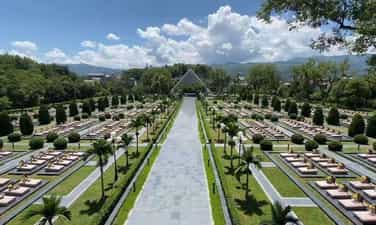
Hill A1 National Martyrs Cemetery
Hill A1 is located in Muong Thanh ward, Dien Bien Phu city, Dien Bien province, and is the most important base in the group of French colonial bases in Dien Bien Phu. Hill A1 is where the historic battle that lasted 39 days and nights between our troops and the enemy took place, contributing to the famous Dien Bien Phu victory in five continents, shaking the earth. A1 is the symbol that the Vietnamese army gave to the hill, while the French army called it Eliane 2. Due to its particularly important position, the French army built A1 to become the strongest resistance in Dien Bien Phu. With an extremely solid secret underground bunker system, strong firepower arrangements, machine gun nests, and battlements so that one defending soldier can fight off many attacking soldiers at the same time. At the same time, France continuously reinforced its strongest forces and provided maximum firepower support to protect this base to the end. Therefore, in the first attack, the 174th Regiment of the Vietnam People's Army launched four consecutive attacks but only captured half of the hill. It was not until dawn on May 7, 1954, thanks to a 1-ton explosive block secretly dug to destroy the underground tunnel system, that the Vietnam People's Army was able to complete the occupation of Hill A1. This was the most fierce battle in the entire Dien Bien Phu campaign, with the highest number of soldiers and casualties. Currently, on the Northwest peak of Hill A1, there is a monument commemorating the soldiers and martyrs who sacrificed their lives, built in the "Three Mountains" style, high in the middle, low on both sides and both shaped like a leader's roof. In front is an incense burner, in the middle is a stele, the National Flag insignia, a yellow star with a red circular background, surrounded by a wreath of flowers. Next to the monument is the body of one of two 18-ton tanks that Quan Ba Hecvuê brought from the center of Muong Thanh to counterattack the Vietnamese army. Another important relic is a funnel-shaped hole as big as a shallow "pavilion pond". That is a trace of our army's thousand-pound explosion, which our soldiers often call "digging a tunnel to conquer a tunnel", conquering both the enemy's bunkers and bunkers. Located not far south of the historical site Hill A1 is Hill A1 National Martyrs Cemetery built in 1958. This is the resting place of 644 military officers and soldiers who heroically sacrificed their lives to protect the country during the Dien Bien Phu campaign. In 1994, the cemetery was renovated, planned and built into a historical and cultural project, a park cemetery with many items. Inside the campus is the manor house designed in the style of a typical stilt house of the Thai Dien Bien people, the outside ceremony platform is designed in the Khue Van Cac style, on both sides are two types of ancient city walls with two moats in front. 6m wide, outside the city wall is a bas-relief depicting the heroic fight of our army and people and the nine years of long resistance to regain national independence. Source: Dien Bien province electronic information portal
Dien Bien
7168 view
Rating : National monument
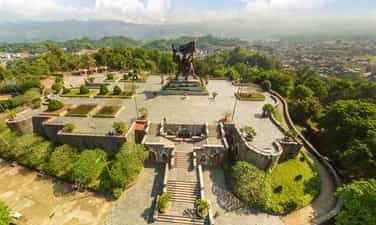
D1 Hill and Dien Bien Phu Victory Monument
Hill D belongs to the Dominique cluster, the French colonialists built and turned this base into the frontline position of the eastern hills. Because the location of Hill D was to shield and protect the Dien Bien Phu Fortress Group Command Headquarters and Muong Thanh Airport, the French colonialists took advantage of the natural terrain to benefit them militarily to build the position. The defense position is extremely solid and powerful. Here, the French army arranged the very battle-hardened 3rd Battalion of the Algerian Regiment to occupy it. As for the Vietnam People's Army, capturing the Eastern peak range, including peak D1, is a very important task in the second attack of the Dien Bien Phu campaign. The unit responsible for destroying D1 base is Battalions 166 and 154 of Regiment 209, Group 312. At exactly 5:00 p.m. on March 30, 1954, artillery guns of the Vietnamese army simultaneously rained down on hill D1 and the eastern high points in the central area of Muong Thanh. Within 30 minutes, the 209th regiment captured D1 hill. The next morning, the French army counterattacked in conjunction with the air force to recapture the base. The battle took place fiercely after 2 days of complete control by the Vietnamese army. D1 hill base. After capturing hill cluster D, Vietnamese soldiers turned this place into a battlefield for the 209th Regiment's firepower, continuing to support other units to capture the remaining French bases. It can be said that the battle that took place on the eastern hills, including D1, was one of the important battles that contributed to the victory in the second attack of the Dien Bien Phu campaign. On the historic land of Dien Bien today, there are a number of monuments and bas-reliefs built to fully, realistically and vividly recreate the great battle of our army and people more than a few years ago. 6 decades, in which the Dien Bien Phu Victory Monument is the largest and only bronze monument in the project of works celebrating the 50th anniversary of the historic victory of Dien Bien Phu. Hill D1 relic was honored to be chosen as the location for the Dien Bien Phu Victory Monument, because the relic is located in the center of the city, has a beautiful terrain, from the relic you can observe the entire Dien Bien basin. Bien Phu. This was the tallest, largest and heaviest bronze statue cluster in Vietnam at that time. The statue was built with a height of 12.6m, mounted on a 3.6m high pedestal and cast with 217 tons of bronze. The Dien Bien Phu Victory Monument stands tall in the midst of historical Dien Bien and together with other relics such as: Hill A1, Muong Thanh bridge, Him Lam, Doc Lap, Ban Keo, Muong Phang.... has become The place is eternal with the country, a testament to the heroic history of the Vietnamese people in the thousands of years of struggle to build and defend the country; creating national identity, passing on heritage to future generations; Strengthen solidarity and attachment between generations of Vietnamese people and among ethnic groups in the area; It is one of the typical symbols for the desire for peace, friendliness, hospitality, always open to welcome friends and international tourists, and the spirit of cooperation and development towards the future. Source: Department of Culture, Sports and Tourism of Dien Bien province
Dien Bien
8764 view
Rating : National monument