Relic point Vietnam
Việt Nam
Quang Trieu Assembly Hall (Ong Pagoda Can Tho)
Located at 32 Hai Ba Trung Street, Can Tho City, Quang Trieu Assembly Hall, commonly known as Ong Pagoda, is a typical religious building of the Cantonese Chinese community. The pagoda was built in 1894, completed in 1896 and still retains its ancient appearance almost intact. The project stands out with its "Quoc"-shaped architecture, closed rows of houses surrounding Thien Tinh yard. The yin-yang tiled roof is elaborately decorated with images of two dragons painting pearls, fish turning into dragons, phoenixes, along with a system of reliefs, horizontal panels, parallel tureens and sophisticated wood carvings. The main hall is the place to worship Quan Thanh De Quan, along with Thien Hau Thanh Mau, Phuc Duc Chinh Than and Avalokitesvara Bodhisattva. Every year, many traditional funeral ceremonies take place here, attracting a large number of people and tourists to worship. Not only has architectural value, Ong Pagoda is also associated with the history of the Chinese community and was once a place to shelter revolutionary cadres during the war years. With these unique values, in 1993, Ong Pagoda was recognized as a National Monument, becoming a prominent cultural and historical destination of Can Tho. Source: Wikipedia
Can Tho
63 view
Rating : National monument

Hiep Thien Cung
Hiep Thien Cung is located in Cai Rang district, Can Tho city, and is a long-standing religious building of the Chinese community. Formed in the 19th century, in 1856, the temple was repaired, expanded and named Quan De Temple. Due to worshiping Quan Thanh De Quan, Phuc Duc Chinh Than and Thien Hau Thanh Mau, this place was later called Hiep Thien Cung. After more than 160 years, Hiep Thien Cung still retains its ancient appearance with its "Quoc"-shaped architecture, including four closed rows of houses and a skylight in the center. The roof of the palace stands out with the shape of two dragons and pearl paintings, the roof is covered with yin and yang tiles, and many intricately carved wooden and stone structures. Inside, there is also a system of diaphragms, tureens and many decorative works with traditional artistic styles. Not only has architectural value, Hiep Thien Cung is also a place for community religious and cultural activities. Every year, many festivals take place here such as Nguyen Tieu, Vu Lan, Via Ba Thien Hau and Via Ong Quan Thanh De Quan. With unique values, Hiep Thien Cung is ranked as a national relic, becoming a cultural highlight that contributes to preserving the identity of the Chinese community and Can Tho cultural heritage. Source: Can Tho Newspaper
Can Tho
89 view
Rating : National monument
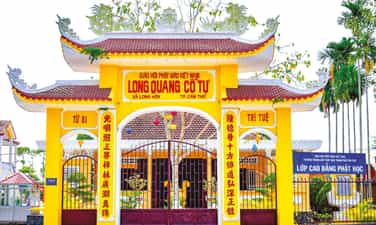
Long Quang ancient temple
Long Quang ancient pagoda is one of the typical ancient pagodas of Can Tho, opened in 1824, associated with the formation and development of Buddhism in the land of Binh Thuy. The temple is currently located in Long Hoa ward, Can Tho city, on the Binh Thuy river. Initially, the pagoda was named Long Truong Tu. Around 1875, the pagoda was renamed Long Quang, both inheriting the tradition of Long Truong and reminiscent of Linh Quang Ancestral Temple. A unique feature of Long Quang ancient pagoda is the system of worship statues made of sandalwood, created by Can Tho artisans, led by Tai Cong Kiem, in 1922. About 50 statues have vivid and sophisticated lines, especially the statues of Ho Phap, Tieu Dien and the Arhat statues. Not only valuable in architecture, art and sculpture, Long Quang ancient pagoda is also a place to hide, communicate and support revolutionary cadres during the anti-French and anti-American period. Today, the pagoda is still an ancient spiritual space, contributing to preserving the Buddhist cultural and historical values of Can Tho. Source: Can Tho Newspaper
Can Tho
293 view
Rating : National monument
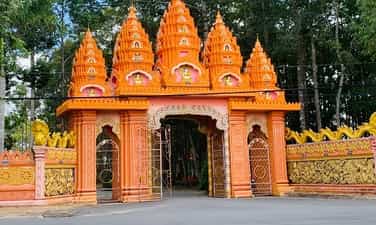
Chroi Tum Cha Pagoda (old Tra Tim Pagoda)
One of the oldest Khmer pagodas in Soc Trang, built around the 15th-16th centuries, is Tra Tim Pagoda. Currently, in Soc Trang city there are 3 pagodas with the same name Tra Tim that people often call Old Tra Tim, New Tra Tim and Middle Tra Tim. Based on its history, the old Tra Tim Pagoda is the oldest and most majestic. This is not only an ancient pagoda but also a revolutionary relic marking the victories of monks and Khmer people of Soc Trang town (now Soc Trang city) in the struggle against America to save the country. Tra Tim Pagoda was started construction nearly 500 years ago, on a high, dry land of 38,600 square meters located in Tam Trung hamlet, Dai Tam commune, My Xuyen district, Soc Trang, now in Tam Trung cluster, ward 10. , Soc Trang city. The pagoda has a unique location because it is adjacent to two large roads of Soc Trang city: Tran Hung Dao street and National Highway 1A. Initially, the pagoda only built a few monk houses for the senior monk and monks in the temple to temporarily rest. Next, the senior monk chose a suitable location for the ceremony to build the main temple, then the meeting house (sala), and the tower. Ash storage, crematorium... all buildings are made of wood or sand, roofed with leaves. Around the pagoda, there are hundreds of ancient oil trees and star trees over 100 years old, which not only create a cool, mysterious and sacred space but also serve to collect wood to repair the pagoda or build houses, boats, and Ngo boats when the trees have grown. old. The temple's architecture has traditional characteristics of the Khmer people, including the main hall, sala, school teaching Pali language for children in the area, crematorium, Ngo boat house of the pagoda, tower for ashes.... Currently, the pagoda still preserves a number of artifacts such as 40 statues of Sakyamuni Buddha made of wood, stone, bronze, glass, cement, 2 dragon lion statues (dragon head and lion body) made of lacquered wood. gold (also known as a deer - tea - masonry), a deer statue made of wood lacquered and gilded, used for monks to sit and preach; 9 main inauguration stele slabs.... Tra Tim Pagoda is not only an artistic architectural work of the Khmer people of Soc Trang province, but also a place marking the victories of monks and Khmer people of Soc Trang town in the direct struggle against the plot to relocate the Khmer people. The temple went elsewhere to expand the US-Diem Soc Trang airport in 1962. Since the airport was established next to the pagoda, it has affected and destroyed the pure, sacred space where the monks practice by the sound of airplane engines operating day and night. This airport location was formerly a horse racetrack for French officers and officials. In 1940, Japan occupied Indochina and in 1941 took prisoners of war and the people of Soc Trang destroyed the racetrack to build Soc Trang airport to serve as a rear base to support the Japanese air force on the Pacific front. It can be said that although the struggle of the people and monks of Tra Tim Pagoda took place within a small town and did not cause any harm, this event became a trigger for the movements. The direct struggle of monks and Khmer people everywhere in Soc Trang province, against the enemy oppressing monks, against the enemy forcing their children who are practicing monks to become soldiers. After the liberation in 1975, until now, Soc Trang airport has been used as a military school of Military Region 9, Tra Tim pagoda is still peaceful, free and is increasingly renovated more spaciously and prominently than before. With those victories, the pagoda has been classified as a revolutionary historical relic since May 12, 2004, according to the decision of the People's Committee of Soc Trang province. The pagoda is also a pioneer in mobilizing and contributing many resources to build rural transportation, great solidarity houses, build a new cultural life, eliminate illiteracy for poor children... with the intention of a good and beautiful life. religion. Source: Soc Trang Tourism
Can Tho
7777 view
Rating : Provincial level relics

Historical relic of Hoa Tien base
The historical relic of Can Tho Provincial Party Committee Base (1965 - 1698) is located in Hoa Tien commune, Vi Thanh city, Hau Giang province. During the resistance war against the American imperialist invasion, Can Tho Provincial Party Committee closed Provincial Party Committee offices in many places such as: Kinh Ngang, Hiep Hung commune, Thanh Hoa, Phung Hiep district, Xa Phien; Vinh Vien, Long My district, but there are two Provincial Party Committee bases standing in to direct the revolutionary movement that created a historical turning point in the province. That was the base of the Ba Bai Provincial Party Committee, Phuong Binh commune, from 1972 to 1975, where from 1972 to 1975, he directed the pacification attack in 1973 and the general offensive and spring uprising in 1975, which won complete victory in the resistance war against Vietnam. America saved the country. This place is often called the Ke Khom base (in Chinese: Key means to eat, Key means to come here to eat Pineapple). After the failure of the "special war" strategy, in November 1965, the US imperialists escalated the war, carried out the "Local War", sent expeditionary troops, vassal troops, and increased current weapons. modern (B52, napalm bomb, chemical agent); At the same time, use the highest firepower of the air force, navy, and artillery to support the puppet army in sweeping and pacifying; carry out a two-pronged plan: "pacify and destroy", pacify the countryside to wipe out the revolutionary base from the people; destroy the main force to break the backbone of the Viet Cong, expanding the war to the North with the air force and navy. For Can Tho, which was the enemy's key pacification center in the Mekong Delta, they sent American advisors and officers to reinforce the operations and pacification agency. The enemy launched many large-scale raids, using direct attack. helicopters, bombardment lights, bombers killed compatriots and destroyed gardens in the liberated base areas of Phung Hiep and Long My Vi Thanh. Faced with that situation, the Regional Party Committee instructed Can Tho province to choose an area to build a base to lead and direct the three-pronged movement in the province to defeat the enemy's pacification plot. Comrade Nguyen Van Nhan (Ba Mai) was assigned the task of Head of the Construction Committee along with a number of officers and soldiers to take advantage of trees and leaves in the available area to build houses for the Provincial Party Committee and service departments. Provincial Party Committee such as: Provincial Party Committee Office, Cipher Team, Code Detective Team, Radio Information Department, Domestic Communications Station, Public Communication Station, Base Department, Security Team, Defense Team. Thus, from February 1965, the Can Tho Provincial Party Committee from Kinh Ngang, Hiep Hung commune, Phung Hiep district moved to the base in Thanh Thang hamlet, Hoa Luu commune, Long My district. From this base, in 1965, 1966, and 1967, under the direction of the Southwest Regional Party Committee, the Provincial Party Committee led the Party, army and people of Can Tho with "two legs and three noses" to break the grip and destroy hamlets. Tan Sinh", besieged and destroyed, forced out many enemy posts, brought people back to their old fields and gardens, the liberated area was expanded to close to towns and townships, creating favorable conditions for us to penetrate deeply to fight the enemy and provide support. for the mass uprising movement to reach the enemy's lair, killing many American-puppet soldiers and causing heavy damage to the enemy. Combined with the activities of the armed forces in the inner city, the Tay Do battalion raided and destroyed the "black tiger" Ranger battalion and severely damaged two Ranger battalions 42 and 44 in Truong Long commune, O Mon. ; The Tay Do battalion attacked the rear of the 21st puppet division in Tra Bet, Giai Xuan commune, close to Can Tho city. To preserve and promote revolutionary traditions, to educate current and future generations; The People's Committee of Can Tho province has recognized the Can Tho Provincial Party Committee base in Thanh Thang hamlet, Hoa Tien commune, Vi Thanh town, Can Tho province (now Hoa Tien commune, Vi Thanh city, Hau Giang province) as a historical relic. provincial level. Source: Hau Giang Province Electronic Information Portal
Can Tho
6729 view
Rating : Provincial level relics
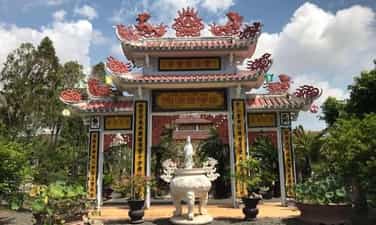
HISTORICAL RELIC OF LINH SON CO MIEU
Linh Son Ancient Temple is located at Thoi Hoa 1, Thoi Long Ward, O Mon District. This is not only the belief base of the Chinese people but also a solid Chinese foundation, contributing to protecting the revolution in the two resistance wars against foreign invaders. According to the elders, after a group of Chaozhou Chinese people came to Thoi Hung village (now Thoi Long ward) and saw the fertile land, they settled down to make a living here. In 1890, people decided to build the first temple made of leaves to worship Quan Thanh De, and at the same time create conditions for contact with Chinese groups far away from their homeland. In 1930, the temple was rebuilt firmly with wood and the roof was covered with yin and yang tiles. Later, it was renovated many times in 2002 and 2004, making the temple more and more spacious and carrying a certain aesthetic value. Linh Son Co Mieu is located on an area of 517.5 m2 and was built in the national-shaped architectural style, with rows of houses arranged perpendicular to each other including: front hall, natural yard, main hall, on the left of the temple is the state house. details, on the right is the gate to the Chinese cemetery, creating a space in the middle called Thien Tinh yard. The temple is surrounded by a fence with iron bars, the main side facing Bang Tang canal. On both sides of the door are a pair of tureens praising the saints worshiped at the Temple: “A thousand years of righteousness and bravery are unmatched. The eternal star is the number one person". The walls inside the Temple are decorated with paintings of Chinese classics, natural landscapes... creating a feeling of closeness and solemnity in the place of worship. The truss system is supported by 4 circular columns embossed in the shape of dragons called dragon pillars. Between the front hall and the quiet courtyard is a pair of "torches and cranes". Next is the Thien Tinh courtyard, the main hall decorated with blue "two dragons flanking the tai chi", below is a screen decorated with lions, mountain and river scenes, apricot, orchids, chrysanthemums, and bamboos symbolizing warm wishes. full, peaceful, happy. The main object of worship at Linh Son Co Mieu is Quan Thanh De Quan; In addition, Linh Son Co Mieu also worships the Earth God, the First Sage, the Later Sage... The worship statues at the Temple are carved in the style of round statues, very simple and rustic, expressing personality through each character's facial expressions, both close to mortals, while also carrying the majesty of the divine world. The architectural style and festivals at Linh Son Co Mieu have contributed to reflecting the typical folk culture of the Chinese people in Can Tho city. From 1950 - 1975, the main hall of Linh Son Co Mieu was also used as a meeting place for revolutionary cadres. Under the altar of the gods is a secret vault that can accommodate 4-5 people. The cellar door is right in the middle of the altar, previously disguised as the Earth God altar. Behind the wooden wall of the back office is also the exit to the cellar disguised by a hibiscus fence. Although many times suspicious enemies came to search everywhere in the Temple, thanks to skillful camouflage and the support of Chinese people, the revolutionary cadres were safely protected. Therefore, Linh Son Co Mieu is not only a religious base but also a historical relic recording the revolutionary struggle of the Chinese people in Can Tho. Linh Son Co Mieu was ranked as a historical relic by Can Tho City People's Committee on March 31, 2008. Source: Can Tho City People's Committee
Can Tho
6853 view
Rating : City-level relics

Serai Cro Sang Pagoda
Seray C-ro Sang Pagoda, also known as Ca Sang Pagoda - is located in Ward 2, Vinh Chau Town, about 40km East-South from Soc Trang city center. This is one of the ancient Khmer pagodas in Soc Trang province with a harmonious architectural complex, dating back over 400 years. The pagoda was built in 1576, with an area of 22,230 square meters. The overall architecture of the temple includes: Main hall, sala, housing for monks, Khmer literacy school, tower for ashes of the dead and crematorium,... The gate of Seray C-ro Sang pagoda is an architectural work built of dark red concrete, below the gate there are 2 square pillars that support the tower roof. The upper archway includes 3 towers embossed with Khmer patterns, on which is written the name Serai C-ro Sang pagoda in Khmer with red letters. The main hall of the pagoda faces East. According to the Khmer concept, Buddha in the West faces East to bless the people, so the pagoda must be built in the East direction to match the direction of worshiping Shakyamuni Buddha in the main hall. The main hall of the current Serai C-ro Sang Pagoda was rebuilt in 2005 under the abbot of Venerable Ly Thi. The main hall was built on two levels higher than other buildings in the temple grounds. In the middle of each edge is a Buddha sitting in meditation facing the four directions with the intention: Buddha Dharma spreads and permeates all four directions. The main hall's ground level is surrounded by fences and there are stairs leading up to the Buddha worship area on each side of the main hall. The roof structure of the main hall is a special structure consisting of 5 towers, including 4 towers located on 4 sides corresponding to the positions of 4 meditating Buddhas below. Each tower is about 5m high and 3m wide at the base. The central tower in the middle of the main hall is about 7m high and 5m wide. It is this special feature that makes the main hall's roof so massive, but it does not lose its elegance and lightness; Each roof level is decorated with stylized dragon images in Khmer culture. Inside the main hall is a large space to worship Shakyamuni Buddha and many different Buddha statues, each reflecting a certain important event in the Buddha's life. Around the inside and outside walls of the main hall are decorated with images of Shakyamuni Buddha's life from birth to nirvana. During the resistance war against foreign invaders, especially the resistance war against America to save the country, Seray C-ro Sang pagoda was both a breeding ground for revolutionary cadres and one of the spearheads for the movements. The struggle of the Khmer people against the oppression of the US-Diem puppet government until the successful revolutionary struggle to liberate the South on April 30, 1975. With that historical significance, on May 12, 2004, the Chairman of the People's Committee of Soc Trang province recognized Seray C-ro Sang pagoda as a provincial-level revolutionary historical relic. Source: Soc Trang province electronic information portal
Can Tho
7608 view
Rating : Provincial level relics

Avalokiteśvara Linh Ung Pagoda (Buddhism 2)
Quan Am Pagoda located next to Dai Ngai river is associated with important historical events of Soc Trang province in particular and the country in general, and was the first place to welcome and care for Con Dao political prisoners returning to the mainland. Quan Am Pagoda is located in Ngai Hoi 2 hamlet, Dai Ngai town, Long Phu district (Soc Trang) with a long history. According to remaining documents, between 1860 and 1872, the pagoda was built and named Quan Am Co Tu. Quan Am Pagoda was initially built with simple leaves, but after many restorations and embellishments, it was completed and spacious as it is today. In particular, here on September 23, 1945, an event of important historical significance took place. Quan Am Pagoda and Buddhists along with the Party Committee, government and people of Soc Trang were honored to welcome and dedicatedly contributed to taking care of the group of loyal revolutionary soldiers of more than 1,800 people, who had just returned to the mainland after years of being imprisoned by the enemy in the "hell on earth" Con Dao. In the group of revolutionary soldiers at that time, there were comrades Le Duan, Nguyen Van Linh, Pham Hung, and many other officials present. The event of welcoming and taking care of the Con Dao political prisoners back to the mainland added strength, helping the Party Committee and people of Soc Trang overcome many difficulties in the early days of building the government and preparing for the resistance war against the colonialists. France. With these great historical meanings and values, Quan Am Pagoda was ranked by Soc Trang province as a Provincial Historical-Cultural Monument in 2004. Today, the pagoda is a place of religious activities for local Buddhists, a place of revolutionary traditional education, as well as a tourist destination for tourists from near and far. Venerable Thich Phuoc Thien - Deputy Abbot of Quan Am Pagoda said: "The pagoda not only meets the religious needs of the people but is also a place to serve the people's amenities and community activities; a place to educate local revolutionary traditions. In addition, I actively participate in social charity activities, helping many people in difficult circumstances. The pagoda connects benefactors from near and far to bring warmth and prosperity to poor people in difficult times, contributing to carrying out social charity work with the locality. The pagoda also does a good job of propagandizing the policies, guidelines, and laws of the Party and State to Buddhists." Every day, the temple welcomes visitors from all over to visit, make offerings, and study; On major holidays there are many tourists. When passing through the three-entrance gate, visitors will see the statue of Guan Yin Buddha standing on a lotus flower right in the temple yard and a few steps to the right is the Dia Mau holy temple. Inside is a stone statue of Maitreya Buddha placed right in front of the main hall. Next is the main hall that is being built, restored with 1 ground floor and 1 floor, concreted, with modern architecture, close to the people of the South. “Like the main hall of other Northern Buddhist temples, the main hall of Shakyamuni Buddha is the main Buddha worshiped. Next to the main hall, there are also Buddhas worshiping Thien Thu Thien Nhan, Tieu Diem, Ho Dharma, Tam The Buddha, and always worshiping Patriarch Dat Ma. At the top of the main hall is a stupa with unique architecture. The temple is a place where Buddhists and local people place their faith. The pagoda is the place for cultural, educational, spiritual and religious activities of the community. The pagoda is closely associated with the lives and activities of the people. In particular, this is also a place with history and revolutionary traditions, so people here are very proud. Source: Soc Trang Online Newspaper
Can Tho
7336 view
Rating : Provincial level relics
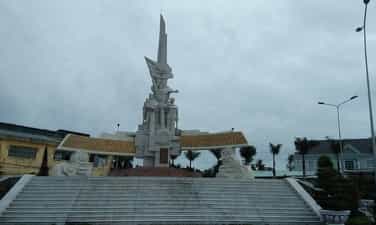
Historical relic site of Victory Branch, Nga Nam Area
The victory of Nga Nam Branch has great significance, affirming the maturity of the Party Committee, army and people of Thanh Tri - Nga Nam in the resistance war against the US to save the country, reducing the morale and prestige of the enemy, causing increase the morale of our army and people. During the war against the US, because Nga Nam had a very important strategic position both militarily and economically, the US and puppet established a military zone here. Nga Nam sub-area belongs to Ba Xuyen sub-area, tactical area 4, located on the land at the beginning of a river with five branches. During Ngo Dinh Diem's time, Nga Nam had many evil puppets gathered here. Among them, Muoi Hung is famous for his wickedness. They once commanded the militia and security forces to drag into the areas around the town, penetrate deep into the countryside, raid, raid, arrest, shoot, kill, imprison... causing pain and suffering to countless civilians. innocent. In early May 1962, the Provincial Party Standing Committee and the Provincial Command Committee directed the provincial armed forces to determine to destroy Nga Nam Branch. With careful preparation, we attacked and completely destroyed the branch, capturing many weapons, military equipment and supplies. Although Nga Nam Branch was destroyed by us many times, the US and puppet tried every way to recapture it, trying to consolidate and build this branch into a solid military base and rearrange the defense system. rigid. Among the attacks that surrounded Nga Nam Branch, the war in 1968 was the longest and fiercest siege. In the early days of the siege, we only used artillery and sniper fire to overwhelm the morale of the enemy soldiers, creating conditions for civil forces to focus on building two fortresses, establishing a siege and attacking more effectively. next steps. The battle to encircle Nga Nam Branch became more and more intense as time went on. When the fortresses were completed, the frightened enemy still tried to risk their lives to attack, but each counterattack was broken. After nearly a month of siege, we defeated the enemy 21 times who risked their lives to send soldiers out to counterattack. Our troops destroyed and injured more than 60 enemies, including many commanders of security forces, military security, reconnaissance and evil puppets. As a result, after 52 days and nights of the siege and invasion campaign, Thanh Tri's army and people received strong support from a part of the provincial forces, and we completely liberated Nga Nam Sub-region. The victory of Nga Nam Sub-region has an extremely great historical significance, it was the first time in the Southwest battlefield, using the siege and invasion tactics of guerrillas and local district-level soldiers (combined with a small part of the province) has completely destroyed a military zone that was among the second most solidly defended in the Mekong Delta. The victory of Nga Nam Branch was the result of determined direction, knowing how to promote the combined strength of many types of troops, in building the people's war posture; persistently cling to the people, build a solid base, be creative, and courageously continuously attack. With nearly 200 enemy soldiers killed, injured, and at the same time disarmed by nearly 100 others during the campaign, it shows that the fighting style of the people's war is correct and that the locality knows how to apply it. The winning site of Nga Nam Branch is located in Ward 1, Nga Nam town, Soc Trang province, ranked by the Ministry of Culture and Information as a National Historical - Cultural Relic, on August 23, 2004. . Source: Soc Trang Online Newspaper
Can Tho
8141 view
Rating : National monument
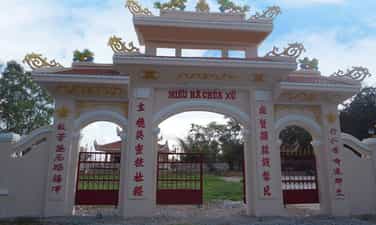
Temple of the Lady of My Dong hamlet
My Dong Ba Chua Xu Temple is located in My Dong hamlet, My Quoi commune, Nga Nam town (Soc Trang). This place is associated with many important historical events of a heroic revolutionary land. Going back in history, My Dong hamlet, My Quoi commune was once a vast, empty land, crisscrossed with rivers and very deserted. At that time, My Dong Ba Chua Xu Temple was built on a foundation about 40cm high, with an area of 2,400m2. The temple is built of bricks, roofed with tiles, divided into 2 compartments, the first compartment worships Ba Chua Xu and her predecessors and descendants, the back compartment is used as a kitchen to prepare worshiping ceremonies. Before 1930, the uprising movement against the oppression and exploitation of the French colonialists and the henchmen of the American Quoi people continued but was not strong. In early 1930, comrade Quan Trong Hoang, a party member, returned to My Quoi village to organize propaganda and foster revolutionary theory for elite youth. From that human resource, in June 1930, the first Vietnamese Communist Party cell of Soc Trang province was established at My Quoi market with comrade Chau Van Phat as secretary. In a short period of time, comrade Chau Van Phat divided his thoughts, prayed for peace, was not steadfast in his stance, forgot his duties, and was disciplined. After that, the superior party organization nominated comrade Tran Van Bay as Secretary of the Party Cell and took My Dong Ba Chua Xu Temple as the location for cell cell activities. In the form of public activities such as organizing martial arts classes, teaching ancient music, teaching the national language... many secret training classes are continuously opened by the Party cell, secretly propagating the revolutionary line, recruiting many members. elite youth joined the Party, thereby promoting the growing development of the local revolutionary movement. After the uprising on November 23, 1940 throughout the provinces of Cochinchina, the French colonialists frantically launched large-scale raids to take revenge on the patriotic revolutionaries. The Temple of Ba Chua Xu in My Dong was also destroyed and leveled by them... It can be said that My Dong hamlet, My Quoi commune is not only the cradle of revolution, where the first Communist Party cell of Soc Trang province was established, but also the revolutionary base of agencies such as: District Party Committee and other organizations. Departments of Thanh Tri district, the Provincial Party Committee's Propaganda Department, the Department of Military Affairs, Communications, Kinh Tai, Civil Military Medicine, the Music and Dance troupe of Soc Trang province and a number of departments of the Bac Lieu Town Party Committee. During the resistance war, many times the French colonialists and then the American imperialists poured bombs and bullets to wipe out the revolutionary forces but still could not shake the iron spirit of the soldiers and people of this heroic countryside. The revolutionary base here was still maintained until April 30, 1975. According to the uncles at the Veterans Association of My Quoi commune, through the two resistance wars against the French colonialists and the American imperialists, many outstanding children of My Quoi's homeland were awarded and posthumously awarded the title of Hero of Strength by the State. People's Armed Forces, with more than 100 heroic Vietnamese Mothers. Through the rain of bombs and bullets during the war years, after the country was at peace, people in My Dong hamlet together rebuilt a temple made of bamboo, wood and thatched with leaves to worship and pray for their homeland. With favorable weather and wind, everyone has a peaceful and prosperous life. In 1997, the province invested funds to build a memorial stele where the first Vietnamese Communist Party cell of Soc Trang province was established. Every year, My Quoi people organize the Ba festival on the 16th day of the second lunar month. On November 27, 2003, Ba Chua Xu Temple in My Dong was ranked by the Ministry of Culture and Information as a National Historical-Cultural Monument. Source: Soc Trang Online Newspaper
Can Tho
9936 view
Rating : National monument