Tourist destination

Le Son Village
Founded in 1471, Le Son Quang Binh village has an area of about 770 ha. Over the past 500 years, Le Son village has been famous throughout Quang Binh with many ancient legends, charming scenery and writer. Le Son Quang Binh village also once ranked first in the bowl of incense of Quang Binh province: Son, Ha, Canh, Tho, Van, Vo, Co and Kim. Le Son Quang Binh village is like a coincidental limestone mountain range, the front is surrounded by romantic Gianh river, deep water like a soft blue silk strip around. Le Son village looks like a water -color picture, if you have the opportunity to travel to Quang Binh, please take the time to come here to admire the beauty of Le Son village. From the beginning to the end of the village is a road full of green bamboo balls stretching along the edge of the river, creating an extremely poetic landscape. Le Son Quang Binh has a back terrain leaning on 99 peaks, it is said that in the old days, there was a flock of 100 phoenix birds flying to find the land to establish the capital of Vietnam, when flying across this land saw the charming landscape, so it landed on 99 peaks in Le Son. Because of the lack of one last parking for the first phoenix, the birds flew away, so Le Son did not have the opportunity to become the capital of Vietnam. Besides, in order to escape the French enemy, Ham Nghi also chose Le Son Quang Binh village as a resting place on the way to Ha Tinh. During the two wars against French and the United States, 99 mountains running along the village were chosen by our army as a revolutionary base. In the old days, the peaks of Thanh Tuyen, Vu vi, Thi Dau, Hoa Cac, Bai Phong ... were shown to guard the French warship from Ba Don's warship from Ba Don. Hanges, Ong cave became the base of Military Medical 108, where the healing and nursing for the army before returning to fight. 99 mountains in Le Son Quang Binh village not only protects the soldiers and people in the years of fighting foreign invaders but also a place to avoid floods. Over the years, Le Son village has not suffered the devastation of floods as well as the sunshine, the harsh wind of the Central. In addition, nature has favored the village of Le Son Quang Binh a very magnificent mountain river terrain. The elderly in the village also recounted: In the past, there was a geography teacher passing through Le Son, when observing the terrain, mountain rivers ... said that this place was a land with a long vein: the dragon's head is located in Le Son, and the tail of the dragon in La Ha. Therefore, in history since Le Son Quang Binh village was established so far, there have been many talented and successful people here. In the old days, Le Son Quang Binh village was classified as "Bat Danh Huong" not only by Ky Tu, My Le mountain river, rich in the elected tradition but also by many young men and women, fertile land, fertile and extremely abundant sources of products. Moreover, Le Son Quang Binh village is also one of the villages with a system of rich cultural and cultural relics, valuable in architecture and art, and there are customs, practices, beliefs as well as diligent, filial piety, morality, honoring the beauty of generations of people in this land. Le Son Quang Binh village is also a place to converge and preserve many unique and pure spiritual cultural values with folk songs, dances, or jokes and folk festivals that make people heartfelt.
Quang Tri
5368 view


Ha Cang Village
Ha Cang village is located in Quang Phu commune, Quang Dien district, Thua Thien Hue province. Surely the young people who like to explore Hue is no stranger to the movie "Eyes" adapted from the novel of writer Nguyen Nhat Anh, but have you visited the village of Ha Cang - the village used as the context in the movie yet? Ha Cang village is not too many people know but when the image is made, every corner also gives you the scenes "expensive to cut" pieces "not wasting at all. Ha Cang village is one of the few villages in the ancient capital of Hue still retaining the simple beauty, full of charming and quiet Hue. The village possesses extremely scenery Hue captured so many passionate believers. The beauty of Ha Cang village is different from the green field, the roof of the elementary school is fluttering in the distance and the dirt roads surrounding small villages in the quiet countryside. The pennywort fields, banana garden, jackfruit, passion fruit, green as well as water wharf, village gate ... still retain the very beautiful beauty extremely beautiful. In particular, the hamlet of pagodas and lonely trees are the two factors that are enthusiastically sought by young people when they find Ha Cang village due to appearing in the romantic love frame of the movie "Eyes". Do not forget to ask people to show the way to the coordinates of this beautiful check-in! Many young people recognize that the peaceful atmosphere in Ha Cang village brings peace in the soul very effectively, especially when admiring the green countryside, murmuring in the wind. How many troubles suddenly disappeared. Coming to Ha Cang village, it is impossible to ignore the copper corn tree, also known as a lonely tree with 45 years old, associated with the childhood of Ngan and the Netherlands in the movie "Eyes", which is a place to stop at the hot summer afternoon of the local people after making the field. Just go to the pagoda hamlet in Ha Cang village and ask the road to the locals and you can find copper corn. However, just checking-in every corn tree is not enough. The sugarcane fields are in the high season that is too high, mixed with the harvested plots that also bring a strange feeling as lonely. The largest Cam Tan sugarcane barn of Thua Thien Hue is extremely famous because it is a sugarcane variety used to be the king in the past, so the check-in between the aisle is also different from foam. Just try pose to see if you can catch any ecstatic moments!
Hue
5384 view


Mount Hon Vuon
The top of the ape is one of the highest mountains in the South, in Huong Ho commune, Huong Tra district, Thua Thien - Hue province. The mountain is covered with rocks, cliffs, canyons, caves, creating a beautiful and unique landscape, but the terrain here is quite steep and difficult, the road to the top of the ape need to overcome large and slippery melaleuca forests. Therefore, you should follow the delegation (7-10 people) and have a guide to facilitate and limit the stray. Hon Mountain Hon Mountain has a height of hundreds of meters above sea level. This place possesses a natural and poetic natural scenery that makes anyone coming to be fascinated. In addition, the peak of the ape is also a military base of the US so this place still retains many revolutionary historical sites such as airports, trenches, shelter, ... The experience of traveling to Hon Members, you are not allowed to immerse yourself in the majestic natural scenery but also have the opportunity to explore the diverse flora and fauna ecosystem. On the top of the mountain is a flat, extremely ideal land for you to organize picnics and camps. With a height of hundreds of meters above sea level, Hon Gibel is a great place for you to look at the Hung Vy mountain landscape, poetic from above. Do not forget to bring your phone or camera to take yourself super -quality check in. Hue Hon Mountain Hon Mountain has always been known as the most wonderful "cloud hunting paradise" in the ancient capital. The feeling of being immersed in the nature of heaven and earth, with white clouds floating around gives you the feeling of being lost in the middle of a fairy. Traveling to Hon Mount Hue Mountain without camping overnight is extremely unfortunate. You can bring a tent, a few small chairs and fast food to organize an interesting outdoor picnic. Hon Gibbon with heroic, wild natural scenery and fresh, cool atmosphere is always considered a destination you should not miss when traveling to Hue. Hopefully these experiences will help you have memorable memories on the upcoming trip.
Hue
5348 view


Duong Long Tower
Duong Long Tower, also known as ivory tower, is a famous Buddhist architecture in Tay Son - Binh Dinh. The tower was built by the Cham community around the 12th century, XIII, the most brilliant development period of Cham Pa culture. This tower complex consists of three towers, each with 10 floors, 33 meters high, 39 meters and 32 meters high and are built in line according to the North - South axis. According to the researchers, removable was built with religious purposes, worshiping the gods in Brahmanism, including Brahma, Visnu and Siva - three supreme gods of Indian religion. Later, kings with meritorious services to the country were also worshiped in the towers. The tower has a massive size and a special shape than other Cham Pa towers. This project is the harmony of Cham Binh Dinh architectural characteristics and Khmer architecture. The perfect combination of tiles construction techniques of the Cham and assembling techniques and creation on the Khmer rock has created a outstanding architectural masterpiece. Duong Long Quy Nhon Tower is popular with tourists not only because of the massive architecture but also for the unique beauty of each tower cluster. All three towers have the same shape and position, located in the North - South direction, the main face towards the east - the residence of the god according to the Cham concept. However, each tower will have different sculptures and decorations, creating the unique value for each tower. Nam Tower: - Worship of Visnu - has the best shape and the most intact architecture. The tower is 32.94 meters high, 14 meters wide, the distance from the Nam to the middle tower is 1 meter. The tower wall was built in the way of breaking the level of the level, protruding towards the door. Besides, decorative motifs such as round breasts, images of gods and sophisticated details on the tower roof such as elephant, lion, nandin cow, kala face, Naga snake, ... are also the highlight that creates the skill and sophistication of Champa architectural art. All of these factors together create a magnificent beauty and attract the attention of people to visit and explore. The middle tower - Siva worship - the highest in the Duong Long tower cluster - 38.1 meters and is the tallest brick tower in Southeast Asia. The main door arches and fake doors of the tower collapsed, seriously damaged. The southern fake door only remains the door, the road is also devastated and collapsed. Around the walls of the tower there are wide covers, no decorative patterns, each wall has 7 pillars, slightly flared head heads, combined with stone blocks, forming many levels of tape. The base is covered with sandstone blocks with square pitches each edge 16.5m long, the protruding part of the fake door is 0.84m. North Tower - worshiping Brahma is the smallest tower with a height of 31.76 meters. This is the most damaged tower in the whole cluster of 3 towers. Before being reinforced in 1984, the body of the tower was deeply carved inside. The tower has a square and size map, the layout of the outside is similar to the male tower. Although the main door has been eroded, we can see that there is still a tall nose -shaped dome. The two door pillars are made of stone, their heads are decorated with a snake -riding Garuda bird statue. The fake doors are designed like the main door, but smaller. On the top of the door pillars is the fierce Kala face, spitting out from the Seven -headed Naga snakes. The roof has a small four -storey structure upward and ends with a large lotus bud on the top of the tower.
Gia Lai
5856 view


Ong Nui Pagoda
Located on the top of the Vung Top, belonging to the Ba mountain range, Ong Nui Pagoda (Linh Phong Tu) appears majestic and majestic among the vast heaven and earth. This temple is not only famous for its beautiful natural landscape but also a spiritual destination with the giant Shakyamuni Buddha image - one of the largest Buddha statues in Southeast Asia. Ong Nui Pagoda gives visitors a sense of peace and release between the sacred mountain space. Here, you can offer incense to Buddha, pray for peace, luck and admire the unique masterpiece of Buddhist architecture. Ong Nui Pagoda, the name is Linh Phong Tu, is located on the top of the Top of Vung in Ba mountain range, in Cat Tien commune, Phu Cat district, Binh Dinh province. This temple has a long history of formation, associated with the name of Zen master Tinh Giac and has experienced many restoration and renovation to get the size of today. At the beginning of the 18th century, Zen master Tinh Giac went to Ba Tu Mountain and built a small Am to meditate. Due to the higher terrain, this place is called "Mount Mountain" by people. Zen master Tinh Giac was also respected by the people as "Mr. Nui". Therefore, his small Am is also called "Ong Nui Pagoda". In 1907, the pagoda was officially built with the name "Linh Phong Zen Tu". Experiencing many restoration and renovation, Ong Nui Pagoda today has become a large architectural complex, including many works such as the main hall, the ancestor church, the Tam Quan gate, the bell tower ... and especially the giant Shakyamuni Buddha statue leaning back on the mountain. Ong Nui Pagoda architecture is a harmonious combination of traditional and modern beauty, creating a worship space that is both solemn and close. The main hall is the main place to worship the temple, designed in traditional architecture with multi -layered roof tiles, exquisitely carved wooden decoration details. Tam Quan gate, the main gate of the pagoda is also built in a traditional style, with 3 separate paths. In addition, the pagoda also has ancestral church, bell tower, gallery ... all designed in harmony with the overall architecture of the temple. The most prominent and impressive architecture of Ong Nui Pagoda is the giant Shakyamuni Buddha statue, built leaning against the cliff. With a height of up to 69m, this is one of the highest Buddha statues in the world, and also the largest Buddha image in Southeast Asia. The Buddha image is made of reinforced concrete, shaping with a meditation posture, peaceful and free. The gentle Buddha's face, radiating the glory as bringing peace and enlightenment to everyone. The ancestor cave is a natural cave located in the campus of Ong Nui Pagoda, where Zen Master Tinh Giac once practiced. The cave has many stalactites with unique shapes, creating a mysterious and interesting space. From Ong Nui Pagoda, you can climb to the top of Vung - the highest mountain in the Ba mountain range. Standing from above, you will admire the panoramic view of the green sea, the immense rice fields and the bustling Quy Nhon city in the distance.
Gia Lai
5890 view


Co Ha Garden
Co Ha garden is located in the corner of the capital of Beijing, in front of the interior, the back of the lake area, the two sides of the East West bordering on the wall of the Imperial City and the Forbidden City. Not only has a large area, nearly 5 samples (2.3ha), the garden is also considered a royal masterpiece because of elaborate and sophistication from structure to bonsai system. When it was newly built in the early 19th century, this place was considered a lower road, that is, the area for the princes to study and play. Until 1837, King Minh Mang was changed to Ngu Uyen garden, and upgraded to wide and planted more trees. However, until the time of King Thieu Tri (1841-1847), the new garden really brought "a new shirt" and became famous for being built more other works such as communal house, hospital, radio, weight, but the most impressive is the Truong Lang range around the main works, known as the most popular in the name of the four-way security. The lower body is taken from the idea of "Van Co Thanh Ha", which means the idle in many mechanisms. With this name, the Nguyen kings set up a garden in order to create a resting place, walk leisurely sightseeing in the middle of the royal court, after many worries and busy because of thousands of government work. Building the garden right in the palace also because they do not want to be too expensive and also convenient for moving from the interior of the palace. Between architectural works and natural scenery, there is harmony and balance to create a poetic softness. Besides, there is a lake called Minh lake located in the middle of the garden with a small Hoan Dao in the center, on the island there is a floor called Quang Bieu. There is also a small bridge that is called Kim Nghe Ngoc Dong. On the left of the lake, there is Ta Ta called Hoa Phong, on the right is the Kha Nguyet corridor. The main gate of Co Ha Vien faced to the south, often called upper Uyen Mon. The east of the garden has Minh Ly Trai, the west is the Nhat Than Hien project. In addition, behind Minh Ho's back there was a small floor called Thuong Thang, built to the north. The main electricity in the lower garden is called Dien Dien Van Van with the hall called Minh Ly, roofing with yellow lip tiles. In addition, there are many other works in all directions. Co Ha garden used to be the most beautiful Ngu Uyen garden of Hue palace. Today, despite many changes and damage, it is still subtle traces of the old garden of old land with the shape of the mountains, floors and thanksgiving for a while. All evoke beautiful natural scenery in harmony with the architectural works of the ancient capital, especially in the inner. Nowadays, visiting Co Ha, you will feel the peaceful silence between the nerve, hidden the charming beauty of an old garden as well as the opportunity to discover the unique features of the art of bonsai of Hue, besides other famous Hue tourist destinations such as Huong Xuan or Con Hen village, ancient village of Thu Le.
Hue
5341 view


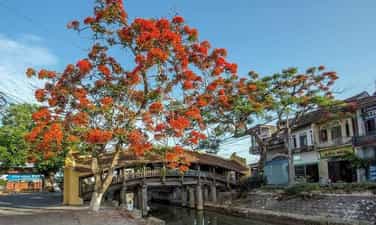
Tile bridge at Luong market
Hai Hau Nam Dinh tile bridge is in the TOP of the most beautiful tile bridges in Vietnam. And this is also a famous destination that attracts many tourists to visit and check in to take stunningly beautiful photos for themselves. If Hoi An is famous for Cau Pagoda, Ninh Binh is famous for Phat Dien tiled bridge... then Hai Hau Nam Dinh tiled bridge is a famous historical relic of the land of Thanh Nam. With more than 500 years old, surpassing the flow of time, Cho Luong tiled bridge still fully retains its ancient beauty, with unique architecture throughout its history. And Hai Hau Nam Dinh tiled bridge is the pride and self-respect of Hai Hau people in particular and the land of Nam Dinh in general. Hai Hau tile bridge is also known as Luong market tile bridge in Hai Anh commune. This is one of the clusters of cultural and historical relics including: "Luong Pagoda - Tile Bridge - Phong Lac Communal House" which is very famous in the ancient land of Quan Anh and was once given 4 words by King Le: "Good customs can be styled". According to ancient historical records, the tiled bridge of Luong Nam Dinh market has the same age as Luong pagoda. And this is one of the 10 oldest bridges in the ancient land of Quan Anh. After more than 500 years of existence, Luong Market tile bridge has entered the TOP of the most beautiful tile bridges in Vietnam while still retaining its ancient beauty and original shape. Next to this tile bridge, the people of Hai Anh commune have built an additional stone bridge to serve the travel of people here. Furthermore, Hai Hau Nam Dinh tiled bridge has been praised by many generations of Son Nam Ha town for its beauty and preserved in the old song: "South Bridge, North Pagoda, Doai Communal House" - Meaning that Luong Nam Dinh market tiled bridge is one of the 3 most beautiful bridges in the North with a scale of: 9 compartments, the bottom is supported by 18 stone pillars arranged in 6 rows. The bridge is built on 18 square stone pillars of 35cm each side arranged in 6 rows to carry 6 pillars and support all 9 bridge compartments. Located on the stone pillars is a system of horizontal and vertical beams made of strong ironwood to support the beams and raise the bridge floor and bridge house. The two sides of the bridge facade are designed and decorated the same with striking yellow tones. Along with that is a letter with a soft shape, inscribed with 4 words "Quan Phuong commune kieu", meaning the bridge of Quan Phuong commune (now Hai Anh commune, Hai Hau district). The tiles used for roofing are male tiles, very skillfully roofed without being pushed or exposed, looking like a meandering dragon rising up. The floor of the bridge is made of wood, with shock absorbers to help ensure safe walking. Inside, there is a system of horizontal and vertical beams made of large ironwood, creating an ancient scene. On both sides of the bridge are two rows of corridors and are also curved along the bridge wall. Outside the hallway is a railing with upper and lower panels and 162 leaf-shaped bars. The corridor is where tourists and residents can stop, sit, rest, and admire the river view. Currently, Hai Hau Nam Dinh tile bridge has attracted many tourists to visit and record the ancient mark of the tile bridge through commemorative photos. More specifically, many young people also eagerly flock here to visit and check in to take beautiful, shimmering photos next to the ancient, ancient tiled bridge. To visit Hai Hau Nam Dinh tiled bridge, you can come at any time of the year. However, if you want to own beautiful virtual photos of the ancient tiled bridge, you can go at the following times: Summer: In my opinion, this is a pretty good time for you to hunt for a lovely photo with a divine angle. Because summer always has clear blue skies and green trees. In particular, this is also the occasion when poinciana flowers bloom, displaying shimmering bright red colors in drops of golden sunlight. So, when visiting Luong Market's tiled bridge at this time, in addition to admiring the charming beauty of the ancient tiled bridge in bright yellow, visitors will also be able to see beautiful rows of poinciana blooming on both sides of the road. This is the background to portray the charming beauty of the ancient tiled bridge and also create a poetically beautiful picture of Hai Hau countryside in the bright red color of red poinciana flowers. If you are afraid of hot weather when visiting Hai Hau Nam Dinh tile bridge in the summer. Then autumn will be extremely suitable for you to visit. At this time, you can wear a graceful ao dai posing next to an ancient tiled bridge with thousands of different photo styles, from different angles that will highlight the radiant beauty of Vietnamese women in pristine ao dai. But for me, I like to come see the Hai Hau tile bridge on the occasion of the Quan Anh festival held from March 14 to March 16 of the lunar calendar every year. Coming to visit during this time, in addition to admiring the unique and ancient architecture of the tiled bridge, you will join the stream of people, joining the people of Hai Anh in participating in the extremely majestic, bustling and joyful palanquin procession festival. We also have the feeling that the tiled bridge of Luong market is like participating in the festival with the people in a proud and excited mood. And this is an opportunity for you to understand more about the spiritual cultural colors of the Hai Hau people. If you have the opportunity to return to the beloved land of Hai Hau, we invite you to visit Hai Hau Nam Dinh tiled bridge to immerse yourself in the ancient, unique architecture that our ancestors built. And certainly, we must immediately make a commemorative photo set with beautiful, sparkling and graceful photos next to the tiled bridge.
Ninh Binh
4949 view


Phu Mau flower village
Phu Mau flower village is located in Phu Mau commune, Phu Vang district, Thua Thien - Hue province. Dubbed the largest and most famous flower bowl of Hue, Phu Mau Flower Village is the main flower granary that provides flowers for the market in Hue. Especially, this place is a lot of attraction for children to love beauty and passion for exploring Hue whenever they have the opportunity to check-in here and there. In recent years in Phu Mau flower village, in addition to traditional flowers such as daisies, dahlia, marigold ... farmers also plant many other new flowers such as lilies, orchids ... Phu Mau flower village is not far from the center of Hue city, so if you want to visit and check-in, there will be a lot of paths for you to choose to move. If you like to go on a trip, you will go on the green village road, and you want to be more romantic, you can go to the ferry to cross the river. The most beautiful Phu Mau flower village is in the lunar month, the time near the New Year, when the atmosphere of spring flooded everywhere, the flowers also show off and bloom throughout the flower village, making Phu Mau flower village more brilliant. And the best time to check-in Phu Mau flower village is on the days of Tet, so please note the schedule of your self-sufficient Hue discovery schedule to visit at the right time, and create more shimmering "virtual pans" for your check-in frame again. If you are a flower-loving person, this place is a love in the journey to visit Hue dreamy, quiet, unmistakable, frivolous. With the beautiful beauty of flowers, Phu Mau Flower Village is the ideal check-in point that you cannot ignore when coming to this romantic Hue.
Hue
5416 view


Hon Chao
In Lang Co town, Phu Loc district, Thua Thien Hue province, Hon Chao is a small island nestled at the foot of Hai Van Pass. It is also known for many other names such as: Hon Son Cha or Hon Son Tra. Although only about 1.5km wide, Hon Pha is favored by nature to give poetic and lyrical natural scenery. It possesses a variety of terrain, including the beach and rocky stacks. At a height of 235m above sea water, Hon Phao Island is as beautiful as a painting painting. Thanks to its pristine and romantic beauty, this island is known as the "pearl island" of Hue and is an attractive tourist destination for Hue tourists. Coming here, visitors are spoiled for surfing, skateboarding, Sup boat or banana float. If you are a fan of adventure and adventure games, you definitely cannot ignore this interesting activity. Coming to Hon Phao Island, visitors absolutely cannot ignore the fresh seafood dishes here. Shrimp, fish, oysters, nhums ... are caught during the day and brought in processing, so they retain the aroma and deliciousness. In addition to seafood, the menu of restaurants on the island also includes many other delicious dishes in Hue. One of the other interesting activities when coming to Hue Hon Hon is scuba diving. Under the turquoise blue water, visitors will admire the colorful coral reefs. In addition, Hon Chao Island is also an ideal residence of many marine species. The ecosystem on the island is extremely diverse with 135 species of seaweed, 162 species of fish and more than 144 species of corals. Coming to Hue Hon Hon Hon without soaking in the clear blue water, it is a great shortcoming. The cool water of the "pearl island" will help you relax and dispel the worries. After enjoying the swimming, you can cope walking on the white sand, watching the natural scenery and giving "the furnace" the holy virtual photos. Hon Hue Island is also considered by many tourist followers as one of the beautiful photography locations in Hue. Camping on the "pearl island" of Hue is also an extremely interesting experience that you should not ignore. This island is still very pristine, so visitors can build camping tents or organize outdoor parties. Hue Hon Hon Island is an ideal place to "escape" every weekend with friends and family. Hon Phao - a tourist destination in Phu Loc Hue is also famous for its pristine primeval forest. The forest here develops is the ideal living environment of many rare species. Tourists come to Hon Hon Hon Hon, in addition to swimming, camping, playing water sports, they also experience exploring primeval forests. Forest exploration, admiring the wild beauty of the mountains here is definitely a very interesting experience. Traveling to Son Cha Island, visitors can transform into fishermen when making ink and fishing themselves at night. You can follow the boat of the people or rent a private boat to catch seafood at night. Then process and enjoy the achievement that I have gained. Certainly this will be an interesting experience in the journey to explore the "pearl island" of the dreamy Hue. Built in the French colonial period, the lighthouse at the top of Hon Phao is a "virtual living" place that many tourists love. If you have the opportunity to set foot in this island, do not forget to record beautiful photos as a souvenir!
Hue
5376 view


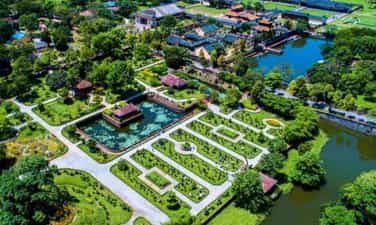
Thieu Phuong Garden
Thieu Phuong Garden is one of the most beautiful upstream gardens in the heart of Hue. Designed with a harmonious combination between the classical architecture and the beautiful nature, the garden used to be the resting place of the Nguyen Dynasty kings. Different from the flashy appearance of the palace or Lau Lau, Thieu Phuong garden brings a peaceful, quiet space and evokes the feeling of relaxation in the hearts of those who have the opportunity to travel to Hue and visit here. As one of the upstream gardens of the palace, Thieu Phuong garden has a sophisticated design, with Asian garden architecture style. Therefore, in addition to being a relaxing garden, Thieu Phuong garden is also considered a symbol of a harmonious combination between nature and people, adorning with small landscapes, lakes and trees to create a vivid picture. The yellow and Tung Bach trees are intercropped, symbolizing eternal and enduring. Flowers in the garden bloom for four seasons, creating a colorful, fresh and vibrant picture. One of the highlights of Thieu Phuong garden is the lake system and small landscapes. Small lakes with horizontal stone bridges, small landscape are cleverly decorated for the garden, and at the same time, it feels peaceful and elegant. The sound of murmuring water, the herds of fish swimming in the lake, all blending to create a quiet, cool and vibrant space. You will feel peaceful and relaxed, with chirping birds, the sound of leaves rustling in the wind. Each step is like bringing you back to nature, enjoying the tranquility and peace of Ngu Uyen garden space. Thieu Phuong Garden is an ideal place for you to keep beautiful moments with ancient and poetic space. From the beautiful miniatures, to the peaceful lake, all bring photos of art and emotional. In addition to relaxing between nature, to Thieu Phuong garden, you also have the opportunity to learn more about the history of the Nguyen Dynasty and the old royal life. Each small corner in the garden tells a story about feudal periods, which preserves cultural, artistic and traditional values. Thieu Phuong Garden is an upper garden as well as a place to preserve the unique cultural and historical values of the Nguyen Dynasty. With the harmonious beauty between nature and royal architecture, the garden is an ideal space for visitors to relax, learn about history and enjoy the rare peaceful space. Traveling to Hue and visiting Thieu Phuong garden, you will experience not only the quiet and cool of nature, but also discover an important part of the life of the Nguyen Dynasty.
Hue
5316 view


