Tourist destination

Co Loa Citadel
Co Loa Citadel was the capital of the Au Lac state under King An Duong around the 3rd century BC and of the feudal state under Ngo Quyen in the 10th century in Co Loa commune, Dong Anh district, Hanoi. Noi. Co Loa today is not only a cultural heritage, a proof of the creativity, technical and cultural level of the ancient Vietnamese people, but also an ideal destination for tourists from all over. Co Loa Citadel is not only associated with the legends of the Vietnamese people, such as King An Duong Vuong establishing the capital and building the citadel, the Kim Quy magic crossbow shooting down hundreds of invaders in one shot or the tragic and touching love story of My Chau - Trong Thuy..., but also a unique tourist attraction of Hanoi Capital. Known as the largest ancient citadel in Vietnam, Co Loa historical site is about 500 hectares wide, built by King Thuc An Duong Vuong in the 3rd century BC to be the capital of Au Lac (the name of Vietnam during the period). that), now belongs to Dong Anh district, a suburb of Hanoi. Legend has it that the citadel has nine spiral-shaped rings, so the people of the ancient citadel also called it Snail citadel. Due to the destruction of time and war, the citadel currently has only three rings left with ancient vestiges, which are the inner citadel, the loyal citadel and the outer citadel. The outer citadel has a circumference of about 8km, built by the method of excavating the soil wherever you go, digging trenches there, building ramparts, and building adjacent ramparts. The ancient ramparts were 4-5m high, especially some were 8-12m high. The central citadel has a circumference of about 6.5km, and has the same structure as the outer citadel but the area is narrower and more solid. The inner citadel has an area of about 2km2, and is the residence of King An Duong Vuong and his concubines, beauties and mandarins under the court. Co Loa Citadel has many different names such as Loa Thanh (Snail Citadel), Con Lon Citadel, Tu Long Citadel, Cuu Thanh Citadel, Viet Vuong Citadel, Kha Lu Citadel, and Co Loa Citadel. In the 10th century, when Ngo Quyen was king, Co Loa became the capital for the second time. Today, in the Co Loa relic site, there are still many historical, architectural, and artistic relics preserved, such as the Thuong temple worshiping An Duong Vuong, the temple worshiping General Cao Lo, the temple worshiping Princess My Chau, and Bao Son pagoda... In temples and pagodas, there are also many archaeological artifacts unearthed in the Ancient Citadel such as bronze statues, bronze arrows and delicately carved porcelain and stone items.
Hanoi
6301 view


Bat Trang Pottery Village
Bat Trang Pottery Village - a village famous for traditional pottery is located about 13 km southeast of Hanoi center. With more than 700 years of history and continuous development, Bat Trang pottery village has become an attractive destination for those who love ceramic art and want to explore traditional Vietnamese culture. - Ly Dynasty: The pottery factory of Thanh Hoa potters was moved here. - Tran Dynasty: Bat Trang Pottery Village became the largest ceramic manufacturing center in the North. - Le Dynasty: Bat Trang pottery reached its peak of development, producing many types of worship items and sophisticated household items. - Nguyen Dynasty: Bat Trang pottery continued to develop but output was not much. - Currently: Bat Trang pottery village has been restored and developed strongly, becoming an attractive destination for domestic and foreign tourists. The pottery village is located in Bat Trang commune, Gia Lam district, Hanoi city, about 10km from the city center and 40km from Noi Bai airport. Therefore, traveling and visiting the pottery village is not too difficult. To get here, visitors can travel by personal means such as cars, motorbikes or public transport such as buses and trains.
Hanoi
5945 view


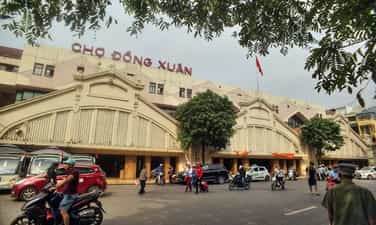
Dong Xuan Market
Dong Xuan Market is one of the largest markets with the most cultural and historical values in Hanoi. Over thousands of years, the market has still developed and has a large number of buyers and sellers trading busily every day. Dong Xuan Hoan Kiem Market in Hanoi is one of the largest markets in the North and is hundreds of years old. Located in the center of the capital, this is not only a bustling place for trade but also a "culinary paradise", a place to "pamper" Hanoi tourists with delicious Hanoi dishes. Dong Xuan Market is located right in the center of Hanoi's Old Quarter, Dong Xuan Ward, Hoan Kiem District. Only about 1km from Hoan Kiem Lake, very close to Long Bien station and Hang Ma street. To the west of the market is Dong Xuan street, to the east is Dong Xuan alley, to the north is Hang Khoai street and to the south is Cau Dong street. Like many other markets, Dong Xuan market is open every day of the week, from 6am - 6pm every day. As for the food court at the market alley, it is open until dawn the next morning. In particular, on weekends Friday, Saturday, and Sunday, Dong Xuan market is open until 10:30 p.m. to serve the sightseeing and shopping needs of tourists. This is one of the crowded and bustling shopping places that tourists cannot miss when traveling to Hanoi. Dong Xuan Market is a large-scale market that has been around for hundreds of years. This place has witnessed many changes in Hanoi over time and is known by another name, Cho Lon. History books record that in 1804, the Nguyen court built a market in the south of To Lich river to facilitate trade by ships. In 1889, after the To Lich River and Thai Cuc Lake were filled, the French government planned and packed the shops into an empty land in Dong Xuan ward. In 1890, the French built the market with a total area of 6,500 m2 according to French architecture with 5 toilets, 5 triangles with honeycomb holes and 5 arches. By 1990, the market was renovated with only 3 middle rows and 3 floors. In 1995, Dong Xuan market was rebuilt with full firefighting, ventilation and escape systems. At that time, the market had an area of up to 14,000 square meters with about 2,000 stalls. This place has become the most modern and busiest market in Hanoi.
Hanoi
6844 view


Hanoi Railway Station.
Hanoi Station is an ancient station built by France, also known as Hang Co Station. The station was inaugurated in 1902, and is the most important transportation hub of the Capital. The station is located right in the city center, at 120 Le Duan Street, Hoan Kiem District, divided into 2 areas: Area A and Area B. Area A specializes in serving Thong Nhat trains, located on Le Duan Street. Area B is located on Tran Quy Cap street, Van Mieu ward, Dong Da district. Hanoi Railway Station is a project associated with many generations of Hanoi people. The sound of the train whistle has become an unforgettable memory for those who lived in the 90s. Through many ups and downs, Hanoi Station is now a modern station with a system of train waiting rooms and passenger waiting rooms. Spacious international transport. In particular, this place is also an attractive destination for tourists on trips to Hanoi. Currently, Hanoi Station has 2 areas, located in 2 different districts in the Capital: Area A: No. 120 Le Duan, Hoan Kiem District Area A is a station specializing in serving North-South trains, the starting point is Hanoi Station and the ending point is Saigon Station. The station operates from Monday to Sunday, from 8:00 a.m. to 10:30 p.m. daily. Area B: No. 1 Tran Quy Cap, Van Mieu ward, Dong Da district Area B is also known as Tran Quy Cap station, a specialized station for trains going to neighboring provinces. Train routes departing from this station include: Hanoi - Hai Phong, Hanoi - Lang Son, Hanoi - Quan Trieu, Hanoi - Dong Dang. The station is open from Monday to Sunday, operating hours are 5:10 a.m. - 6:00 a.m., 8:00 a.m. - 11:30 a.m. and 2:00 p.m. - 5:30 p.m.
Hanoi
6511 view


West Lake
West Lake is one of the famous beautiful landscapes in the capital Hanoi, where there are many historical and cultural relics associated with the history of formation and development of the ancient Thang Long Citadel and today's Hanoi. The beauty of West Lake is a romantic, poetic highlight in the colorful picture of Hanoi, a meeting place, marking memories of many Hanoians, a place that holds tourists back every time they visit. dollar. West Lake is a natural lake located in the northwest of Hanoi inner city with an area of about 500 hectares, the road around the lake is nearly 20km long. Historical documents show that thousands of years ago, West Lake was the remaining section formed by the Red River's diversion. West Lake used to have many names such as Mu Suong Lake (Dam Dam), Trau Vang Lake (Kim Nguu Lake), Xac Cao Lagoon... Each name is associated with the story of the origin of the lake's formation. West Lake has the position of "Dragon and phoenix reporting the wall - Phoenix wet in water", on the shore is favorable for silkworm cultivation, underwater is favorable for navigation and fishing... That's why during the Ly dynasty (1138), Princess Tu Hoa, the son of King Ly Than Tong, left the palace and returned to the area along West Lake to teach people how to grow mulberries and raise silkworms, forming a land famous for its silk industry, famous throughout Thang Long Citadel. The kings and lords of the Ly - Tran dynasties also chose the area along the West Lake to build palaces to visit, such as: Thuy Hoa palace in the Ly dynasty, in the Tran dynasty, it was renamed Han Nguyen palace and now belongs to Tran Quoc pagoda; Tu Hoa Palace under the Ly Dynasty now belongs to Kim Lien Pagoda; Thuy Chuong Palace during the Le Dynasty now belongs to Chu Van An High School... Viewed from above, West Lake is shaped like a crab claw with the eastern corner surrounded by Thanh Nien Street - the road separating West Lake and Truc Bach Lake, the rest is surrounded by land. West Lake is not only beautiful because of its vast blue water surface, which is bobbing and wavy all year round, but also has a poetic beauty because of the fragrant pink color of lotus flowers, the purple color of linden flowers or the brilliance of pink phoenix petals. every summer comes. The space around the lake is always filled with cool breezes, making everyone who comes here feel relaxed. Every morning or at sunset, many people like to walk around the lake to breathe fresh air or exercise before starting a new work day or returning home. In the late afternoon or when night falls, West Lake becomes a place to meet friends, go on dates, and keep memories of love for many people. Some people find themselves a corner by the lake to enjoy the breeze, sip a cup of coffee at a roadside shop, enjoy the famous shrimp cakes, and eat a cool glass of fresh ice cream. There are also people who choose luxury restaurants located along the lake to eat while admiring the scenery and enjoying the fresh breeze. With its romantic beauty, West Lake also inspires creativity for many poets, writers, and musicians to create literary works and lyrical and poetic love songs. Located along West Lake, there are also ancient villages such as: Nhat Tan flower village, Quang Ba flower village, Nghi Tam kumquat village, Yen Thai do paper craft village, Ngu Xa bronze casting craft village... along with a system of historical and cultural relics. Concentrated cultural areas such as: Van Nien Pagoda, Tao Sach Pagoda, Kim Lien Pagoda, Quan Thanh Temple, Ba Danh Pagoda... In particular, on the peninsula and island in the east of West Lake, two famous relics are Tay Ho Palace. (built around the 17th century to worship Princess Lieu Hanh - one of the four immortals of Vietnamese folk beliefs) and Tran Quoc Pagoda (built in the Pre-Ly Dynasty (6th century), moved and restored in Le Trung Hung Dynasty (1615) on the old foundation of Han Nguyen Palace) is still preserved intact, attracting a large number of domestic and foreign tourists to visit, sightsee, and worship at the pagoda. In addition, to serve the enjoyment needs of tourists, TLC West Lake Company has put into operation tours to visit and sightsee West Lake and surrounding areas by electric vehicle such as: "Sightseeing West Lake ", "Dawn of West Lake", "Excursions to West Lake"; "Visit Ngu Xa bronze casting village", "Visit Nhat Tan flower village"... Joining these tours, visitors will not only enjoy the beauty of West Lake today but also have the opportunity to reminisce about " Tay Ho bowl scene".
Hanoi
5950 view


Hanoi
Hanoi is located on the left bank of the Da River and on both sides of the Red River Delta. The North borders Vinh Phuc and Thai Nguyen provinces, the South borders Hoa Binh province, the East borders Bac Ninh and Hung Yen provinces, and the West borders Vinh Phuc province. After expansion, Hanoi is in the top 17 capitals with the largest area in the world with 3,324.92 km2. With this favorable geographical location, this city can easily become an important economic, political, cultural and scientific center of the country. Currently, it includes 12 districts, 1 town and 17 districts. Due to the humid tropical monsoon climate, when traveling to Hanoi, you can enjoy all 4 seasons of the year. Each season has its own characteristics, giving you different feelings about life, the landscape and the people here. Hanoi is very cold in the winter, and very hot in the summer, but that doesn't take away its beauty. But perhaps the most special is spring and autumn in Hanoi. Hanoi, from its early days as Thang Long Citadel, has always been the largest cultural center of the country. This land has given birth to a folk culture with many legendary stories, many folk songs, proverbs, many folk festivals and even praised heroes, tangible and intangible cultural relics. recognized object. One thing when introducing Hanoi - Hanoi is very special with many different cultures, and there are no more cultural villages like this place. Along with that, there are villages with Buddhist, folk, and French architecture scattered everywhere, making visitors excited when lost in a bustling, developed city like Hanoi. cultural values thousands of years ago. Hanoi traditions exist from the smallest things, from saying "thank you", "sorry" to how to greet and invite each other. Everything has been unified in educational standards so that everyone loves it. That tradition is also expressed in traditional craft villages, streets selling unique items such as Bat Trang ceramics, Hang Ma street, Hang Bac street,... Religion and belief have long become an important part of the spiritual life of Hanoi people in particular and Vietnamese people in general. This land has many religions such as Buddhism, Taoism, Confucianism, Protestantism, Islam, Cao Dai,... to serve the needs of the people's cultural and religious life. Every time we introduce Hanoi, we cannot help but mention the people here. Hanoi is characterized by its simple people, their civilized and polite speech and behavior. If one day you visit the capital, you will see that there is always warm people, everyone is always ready to help and give dedicated guidance on roads, vehicles, and accommodation when you are a stranger. far away traveler. And next to the ancient features of thousands of years, next to the old street corners and peaceful lifestyle. Visitors will still feel the bustling atmosphere of a city that is the capital of this country. In the morning, the roads are crowded with people, especially during rush hours. At night, Hanoi returns to that atmosphere, peaceful, ancient, brilliant in the night lights.
Hanoi
8654 view


Ham Long Church
Ham Long Church is one of the largest churches in Hanoi, located at 21 Ham Long Street, Hoan Kiem District, whose patron is Saint Anthony of Pavoda. This architectural building was designed by architect Doctor Than, who studied abroad in France before returning to Vietnam. The church was completed in December 1934, is 17m high and has extremely unique architecture. The most special feature of Ham Long church lies in the choice of materials. Thanks to the use of folk materials such as cork, paper combined with lime straw and a few other special materials to create dome details without the help of equipment. Modern sounds, the sounds of ceremonies are still echoed very loudly. Not only that, the uniqueness of Ham Long church also comes from the motifs, the most famous of which is the rope motif, like the straps of the Franciscan order, carved on the church pillars as well as the on altar pedestals. The land of Hanoi has many architectural works with high historical value, but Ham Long church is always an attractive destination not only for parishioners but also for those who love to learn about public culture. teacher. Known as one of the most beautiful churches in Hanoi, don't miss the opportunity to visit Ham Long church if you have the opportunity.
Hanoi
6315 view


Me Linh Flower Village
In Hanoi, perhaps everyone is too familiar with names like Nhat Tan flower village, Ngoc Ha flower village or Nghi Tam, Quang Ba. These are not only flower villages with famous beautiful scenery over time, but also carry deep historical and cultural meanings, contributing to the poetic and famous beauty of this ancient land. Not as old as Nhat Tan flower village, Me Linh flower village is known to many people because it is the main flower supplier for Hanoi and some northern provinces on holidays. Flower growing has been established on this land for more than 20 years. The soil here is most suitable for growing roses. On frosty nights, Me Linh flower garden is beautiful under the light of hundreds of lights running across the field, creating a special scene. With fresh, vibrant scenery and fresh, natural atmosphere, Me Linh flower village is becoming one of the interesting tourist destinations in Hanoi. Not only is it popular with young people, it has become the number one choice for many families' weekend picnics. The flower village is located 30 km from the city center, near Noi Bai airport. Visitors can ride a motorbike or take bus number 7. From the center of the capital, tourists follow Thang Long bridge to the overpass into Thang Long industrial park, turn onto the road to the industrial park but do not go inside. If you continue about 5km, you will reach Me Linh flower village. Visitors will also immediately see vast flower fields on both sides of the road. People in Me Linh grow many types of flowers such as roses, chrysanthemums, peonies... But the most popular are still roses including velvet roses and red roses. The flowers here have bright, diverse and eye-catching colors. Just standing from afar can feel the smell of flowers blowing in the wind, giving visitors a very enjoyable feeling. Visitors will be even more interested in the rustic, rustic simplicity of the scenery here. Fresh air and a feeling of relaxation are also factors that make visitors reluctant to leave. That is the advantage that makes Me Linh flower village a priority choice when compared to other flower villages such as Nhat Tan or Quang Ba. Because while other flower villages, because they emphasize commercialism too much, have replaced the natural beauty of the landscape with the gaudy, gaudy appearance of artificial decorations, the naturalness and rusticity of flower villages Me Linh has become an impressive attraction for tourists. If in 1995, Me Linh commune (Me Linh district) only had 2 hectares of flower growing, then now the whole commune has 236 hectares. In Me Linh, most households grow and trade flowers. Flowers in the fields and gardens are all covered, making the village here always colorful and bringing a prosperous life to the people. Of the 236 hectares planted with flowers, roses and chrysanthemums play the leading role. In addition, Me Linh farmers also grow a number of other flowers such as lilies, calla lilies, peonies, gladiolus...
Hanoi
7062 view


Quan Thanh Temple
Quan Thanh Temple is located at the intersection of Thanh Nien Street and Quan Thanh Street, opposite West Lake, which is always cool all year round. Built in the Ly Dynasty, Quan Thanh Temple is also called Tran Vu Quan because it is a place to worship Huyen Thien Tran Vu - a deity guarding the north of the ancient capital Thang Long. Right from the entrance gate, you will be impressed by four pillars decorated with back-to-back phoenix images and flanked by ancient screens. Around the pillars are a pair of striking red parallel sentences. Stepping inside, you will be amazed by the ancient space of the three-entrance gate, the courtyard, and the three layers of the front house - the middle house - the harem in Chinese architectural style. With extremely unique wood carvings in a harmonious space, the temple's architecture has extremely high artistic and aesthetic value. The most prominent highlight in Quan Thanh Temple is the statue of Huyen Thien Tran Vu cast in black bronze with a height of nearly 4 meters and weighing about 4 tons on a marble block more than 1 meter high. In ancient legends, Huyen Thien Tran Vu is the god who fought off many foreign invaders, helped the people of Thang Long exorcise evil spirits and monsters, and govern the North. The statue has a square face that is majestic but gentle and calm with straight looking eyes. This is a unique work of art and partly affirms the ingenuity and talent in sculpting and bronze casting techniques of Vietnamese artisans three centuries ago. The statue is placed in the Harem area. Every month or Tet holiday, people flock to Quan Thanh Temple to pray for health, peace and fortune. Legend has it that if you use your right hand to rub the left leg of Huyen Thien Tran Vu statue, the person rubbing will receive good luck and prosperity. In addition, the Quan Thanh Temple festival also takes place every year on the 3rd day of the third lunar month, attracting a large number of people to offer incense, sacrifice and pray for peace.
Hanoi
6724 view


Long Bien Bridge
Long Bien Bridge connects Long Bien, Hoan Kiem and Ba Dinh districts. The bridge is the symbol of Hanoi. This is the first steel bridge across the Red River. The bridge was once in the top 2 longest bridges in the world, just behind the Brooklyn Bridge across the East-River of the US. After many years of formation and development, Long Bien Bridge in Hanoi has accompanied our people through two resistance wars against the French and American colonialists. The bridge has witnessed many heroic and memorable historical events and milestones. Long Bien Bridge has become a beautiful and meaningful symbol of Hanoi Capital. The bridge is always imprinted in memories and has become a source of national pride. Long Bien Bridge has an extremely unique architecture with a length of 2,290m across the river, 896m of bridge with 19 steel beam spans and 20 sturdy high pillars. When inaugurated, the bridge was compared to the "horizontal Eiffel Tower" with its harmonious and meticulous design. The bridge is 4.75m wide with 3 lanes. The two lanes on both sides for cars, motorbikes, and bicycles are 2.6m wide, the outermost lane for pedestrians is 0.4m wide. The middle lane is the railway lane, for trains, 1.75m wide. The bridge was built according to famous French architecture, designed and constructed by Daydé & Pillé company (Paris, France). Modern bridge construction techniques ensure safety and high aesthetics. The entire bridge is made from high quality steel, stacked tightly together to create a harmonious and impressive whole. From afar, the bridge looks like a giant, soft, winding dragon, lying across the fast-flowing river. Time passed, the devastation left behind by the war was extremely heavy, but the bridge was still there, still standing tall. Long Bien Bridge is a historical witness of the Vietnamese people, with the nation experiencing many important historical events and milestones. The bridge marked each step forward in the two resistance wars against the French colonialists and the American imperialists. The bridge has always accompanied our people during the arduous and difficult days of fighting against invasion. And until witnessing the moments of joy and excitement when the South was liberated and the country was unified. Let's look back at the historical events of Long Bien Bridge: September 2, 1945: At historic Ba Dinh Square, President Ho Chi Minh read the Declaration of Independence, the bridge became a bridge leading thousands of suburban people to Uncle Ho in joy and jubilation. October 1954: On the day of liberation of the Capital, the bridge still stood tall, witnessing the joy and pride of the nation. 1965-1968: During the Rolling Thunder campaign, the bridge was bombed 10 times by American aircraft, losing 7 spans and 4 pillars. September 10, 1972: During Operation LineBacker II, the bridge was bombed 4 times, damaging 1500m of the bridge and 2 large pillars were cut off, causing heavy damage. December 30, 1972: When the US was forced to stop bombing Hanoi, workers repaired the railway on the bridge. 1975: On the day of liberation of the South and unification of the country, Long Bien Bridge once again witnessed this joy and pride with our people. Long Bien Bridge has witnessed and accompanied the Vietnamese people for a long time. Having gone through many ups and downs and events, now the bridge is not only a historical witness but also an extremely close companion to every Vietnamese person.
Hanoi
6292 view


