Relic point Vietnam
Việt Nam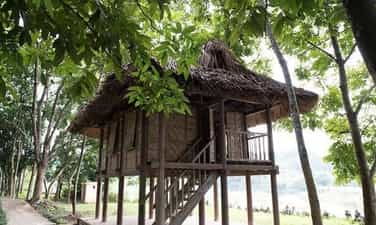
Relics of Comrade Ton Duc Thang's Housing and Safe Tunnel
The relic of Comrade Ton Duc Thang's House and Safe Bunker is located in Chi Lien village, (now Dong Ma village), Trung Yen commune, Son Duong district. Where comrade Ton Duc Thang, Acting Head of the Standing Committee of the National Assembly and Chairman of the Lien Viet Front, lived and worked from the end of 1952 to 1954. The house is located next to the Pho Day River, surrounded by lush greenery. good, helping to facilitate secret communication between places in the region. This is a wooden stilt house with 2 vertical compartments and a palm leaf roof. The outside of the house is the place to work and receive guests; The inner space is where Uncle Ho rests. Close to Uncle Ton's house is a safety tunnel dug about 10m deep into the Chi Lien mountainside, 10m horizontally, with 2 two-way doors. These are two typical relics among the revolutionary historical relics that were once associated with the revolutionary life of comrade Ton Duc Thang in Tuyen Quang during the arduous period of the resistance war against the French colonialists. Kim Quan relic site is more than 40 km east of Tuyen Quang town, spreading in the Na Loi and Vuc Nhu forests, Khuon Dien village, Kim Quan commune, Yen Son district. The Pho Day River surrounds the forest, making it convenient for transportation and living while also ensuring confidentiality. The Party Central Committee office area is 200m northeast of the Government Office. Here, there is a hall, the house of General Secretary Truong Chinh, the house of comrades Hoang Quoc Viet, Le Van Luong and parts of the Central Office: radio station, archives, library, and security guards. Vuc Nhu location where Uncle Ho lived and worked. Uncle Ho's house is a stilt house built on a mountainside. Not far from the stilt house is a shelter. The house is connected to the tunnel by a zigzag trench. The entire office, house, and hall are made of wood, bamboo, leaves... the shelters are dug deep into the mountain, covered with wood on all four sides. Particularly, the basement of the Party Central Committee office area has an exposed section on the outside, this part has a high mound, creating a zigzag-shaped entrance to the tunnel. Kim Quan is also the place where Uncle Ho, the Party Central Committee, and the Government receive international guests. From here, Deputy Prime Minister and Minister of Foreign Affairs Pham Van Dong went to attend the Geneva conference. The relic site has been ranked as a national monument by the Ministry of Culture and Information. Source: Vietnam Travel Association
Tuyen Quang
5888 view
Rating : National monument

Bong Cave
According to the book Historical relics - souvenirs of President Ho Chi Minh on Tuyen Quang land published by Tuyen Quang Department of Culture, Sports and Tourism in 2010, Bong cave, Bong village, Tan Trao commune (Son Duong) This is where President Ho Chi Minh stayed the longest during the resistance war. From a small, simple shack in front of Bong cave, Uncle Ho signed many important decrees, chaired many important meetings of the Government, wrote newspapers, and wrote poetry. During his days here, Uncle lived a simple and pure life, always giving care and love to everyone. At Bong Cave, Uncle Ho lived and worked 3 times: The first time from May 1951 to December 1951, the second time from January to April 1952, the third time from June to the end of 1952. . At Bong cave shack, despite being busy with thousands of jobs, Uncle Ho still spent time playing with the children, increasing production, and practicing sports. Every day, Uncle Ho still went to Pho Day river to bathe. When he returned, he did not forget to bring a few small stones to line the steps to make it less slippery on rainy days. Many touching stories about Uncle Ho's brilliant revolutionary qualities and love for officers, soldiers and people here are still told. From Bong Cave, President Ho Chi Minh set out to the location of the expanded Politburo meeting scheduled to take place on May 25, 1951. It was raining heavily, the stream water rose, he swam across the stream and soaked in the rain to get there. attend the meeting. Also here, Uncle Ho gave blankets and covers to protect the officers from the cold in the middle of a cold winter night, gave rice to the officers to eat to avoid hunger, and told the officers to sleep in the shacks to avoid fatigue. It was Uncle Ho's immense love that urged the cadres who lived near Uncle Ho to overcome all difficulties and hardships to complete the assigned tasks during the resistance war and forever after. Bong Cave Shack is also where Uncle Ho wrote many articles and articles on self-criticism and criticism, preventing bureaucracy, embezzlement, and waste. Three times President Ho Chi Minh lived and worked in Bong cave shack. He worked passionately, enthusiastically, without rest. Many orders and directives were issued and transmitted nationwide, leading the revolution to move forward steadily. Important decisions have changed the battlefield situation, diplomatic relations have been built and strengthened, bringing Vietnam's political position to new heights, financial and monetary work has been focused on creating strength for the resistance economy. From here, he set out on a business trip abroad, going to the front to direct the campaign. Source: Tuyen Quang Newspaper online
Tuyen Quang
5458 view
Rating : National monument

Hong Thai Communal House (Kim Trien Communal House)
Before 1945, Hong Thai communal house was also called Kim Chien communal house in Hong Thai village, Tan Trao commune. The communal house was built to meet the needs of cultural and religious activities of the community and was a place to meet and discuss important matters. common work of the village. In March 1945, under the leadership of the Party, directly comrade Chu Quy Luong, the people of Kim Chien rose up in an armed uprising to seize power. After gaining power, the people met and decided to change the name of the village. The people took the name of martyr Pham Hong Thai as the name of their commune and Kim Chien communal house has also been named Hong Thai communal house since then. Hong Thai communal house was built according to feng shui techniques passed down from ancient times, that is: "earth gathers water, water gathers". In fact, the communal house is placed in the south direction with Thia mountain as the communal house, in front is the Pho Day river, in front of the communal house is a large yard with many old trees such as banyan trees, rice trees... The communal house was built in the 4th year of Khai Dinh's reign, in 1919. The communal house has pure wooden architecture and a palm leaf roof. Overall, the communal house has the appearance of a mountain house on stilts, consisting of three rooms and two wings. The two sides on both sides are used as meeting and dining places, and the three middle rooms are used as places of worship. Above the middle space there is a mezzanine floor, divided into two parts: the upper part is used for offerings, the inside is the palace where offerings are stored. Unlike communal houses in the lowlands, Hong Thai communal house has a very simple architecture. What stands out are the letters painted in black ink at the ends. In addition, in the middle space we also see the image of 6 geckos clinging to 6 columns. In addition to its architectural and decorative value, this is also one of the agricultural beliefs of the people, because they believe that geckos are animals that can predict whether the weather will be rainy or sunny, and from there one can calculate the growing time of the crop. Hong Thai Communal House worships mountain gods around the region. In addition, the communal house also worships a human deity, Princess Ngoc Dung. Every year, the villagers here organize many worshiping ceremonies at the communal house, and the holidays are based on the seasons of the year. On May 4, 1945, Uncle Ho returned from Pac Bo, Cao Bang to Tan Trao. Hong Thai Communal House was the first stop when he arrived at Tan Trao. In August 1945, the revolutionary movement developed strongly, the spirit of seizing power was burning everywhere. Uncle Ho and the Party Central Committee decided to convene the Party's national cadre conference at Tan Trao communal house. Hong Thai Communal House was chosen as the place to welcome delegates to the Congress. All delegates must present documents at Hong Thai communal house before entering Tan Trao. After the success of the August Revolution, Uncle Ho and the Party Central Committee moved to Hanoi. Not long after our country was at peace, the French colonialists broke their promise and returned to invade our country again. The nationwide resistance broke out, the revolutionary homeland of Tan Trao once again welcomed Uncle Ho, the Central Committee, and the Government here to direct the resistance war against the French colonialists. During the resistance period, Hong Thai communal house became the headquarters of the Zone Safety Protection Board. Everyone who wants to enter a central agency to work must go to Hong Thai communal house, present documents, and have the signature of the person in charge to be able to safely enter the area. In addition, Hong Thai communal house was the workplace of the ATK Supply department during the resistance war. After this department moved, many army units were stationed at Hong Thai communal house to train army units. Source: Tuyen Quang Tourism Promotion Center
Tuyen Quang
5908 view
Rating : National monument
Tan Trao Communal House
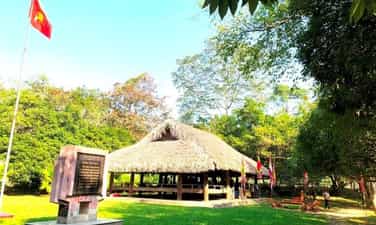
Tan Trao communal house is located in Tan Lap village, Tan Trao commune, Son Duong district, Tuyen Quang province. Previously, the communal house was called Kim Long, built in the 6th year of Tu Duc (1853). Tan Trao Communal House was chosen by Uncle Ho and the Party Central Committee as the place to hold the National People's Congress on August 16 and 17, 1945, an important historical event that created the premise for the successful August Revolution. Tan Trao Communal House is a communal house worshiping Thanh Hoang and the river and mountain gods of Tan Lap village. The communal house was built in the year of the Pig (1923) in the style of a stilt house, with wooden columns, 3 compartments and 2 wings, and a roof thatched with palm leaves. Under this communal house, on August 16, 1945, Delegates from all over the country came to meet the National Congress. Here, the Delegates approved the Party's policy of conducting a general uprising, passed the Uprising Order and 10 major policies of the Viet Minh, stipulating that the national flag was the red flag with a yellow star, and the national anthem was Tien Quan. ca and appoint the Vietnam National Liberation Committee, the Provisional Government, chaired by comrade Ho Chi Minh. On the morning of August 17, 1945, on behalf of the National Committee for the Liberation of Vietnam, Uncle Ho read the sacred oath at the National Launch Ceremony here. Implementing the General Uprising order, with the tenacious spirit of the Tan Trao National Congress, the whole country successfully conducted a general uprising to seize power, establishing the Democratic Republic of Vietnam. The Tan Trao National Congress is an important event in the history of the Vietnamese revolution, the second "Dien Hong Conference" in our nation's history. The Tan Trao National Congress was the forerunner of the National Assembly of the Democratic Republic of Vietnam, later the National Assembly of the Socialist Republic of Vietnam. The 10 policies of the Viet Minh are also the premise of our country's first Constitution. Tan Trao Communal House is a red address on the journey back to the origin, a place to educate patriotic traditions and national pride. Source: Tuyen Quang Radio and Television Station
Tuyen Quang
5343 view
Rating : National monument
Tan Trao Banyan Tree
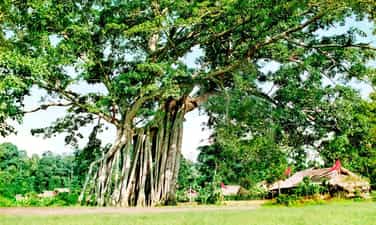
Tan Trao banyan tree relic in Tan Lap village, Tan Trao commune, Son Duong district, Tuyen Quang province. Tan Trao banyan tree is a historical symbol of Tan Lap village, where important events took place during the resistance war against the French of the Vietnamese people. This banyan tree is not only the protector of the people here but also a living witness to the heroic days of Tan Trao's army and people. Under the Tan Trao banyan tree, on the afternoon of August 16, 1945, General Vo Nguyen Giap read the Military Order No. witnessed by all Viet Bac ethnic people and 60 national delegates. From then until now, Tan Trao banyan tree has become a revolutionary symbol of the Capital of Tuyen Quang Liberation Zone. The Tan Trao banyan tree has two towering branches that people call the banyan tree and the banyan tree. Both trees are located 10mm apart and have very lush branches and leaves. Through many historical events, the banyan tree gradually ages and weakens. In 1993, due to the impact of a storm, the "banyan tree" fell, leaving only a small branch. The "banana tree" cannot avoid the law of "birth and death", gradually showing bad signs, the leaves turn yellow, and some tops die. By 2008, the Tan Trao banyan tree had only one left branch facing the Northeast of the "banana tree" that was still alive but was not growing well, the main root of the tree was almost dead. Faced with that urgent situation, the local government has coordinated with organizations and businesses to come up with plans to care and revive the Tan Trao banyan tree. With much effort, after 2 years the Tan Trao banyan tree has gradually recovered, more young shoots have appeared, signaling that life will flourish strongly. And to this day, the "banyan tree" has developed into 2 root clusters consisting of 38 large and small roots, with a wide canopy that radiates cool green shade. The small branch of the "banyan tree" has also recovered and grown into a lush new cluster of trees. Tan Trao banyan tree relic is located in the Tan Trao special national relic area of Tuyen Quang province. Source: Tuyen Quang Tourism
Tuyen Quang
9542 view
Rating : Special national monument

Na Nua Shack
Na Nua shack (also known as Na Lua shack) is in Tan Lap village, Tan Trao commune, Son Duong district, Tuyen Quang province. This is where President Ho Chi Minh lived and worked from the end of May 1945 to August 22, 1945 to prepare and lead the August 1945 General Uprising. On May 21, 1945, after 18 days and nights through the forest, starting from Khuoi Nam - Pac Bo (Cao Bang), Uncle Ho returned to Tan Trao, Son Duong district (Tuyen Quang) to prepare for the General Uprising. August 1945. Uncle Ho's first stop when arriving at Tan Trao was Hong Thai communal house. After preliminary grasping the situation and the expected terrain where the Central "headquarters" would be located, Uncle Ho and the officials crossed the Pho Day river into Tan Lap village, Tan Trao commune. Initially, Uncle Ho came to stay at the house of Mr. Nguyen Tien Su, Head of the Viet Minh commune, located in the center of Tan Lap village. At the end of May 1945, Uncle Ho moved to a small shack in the Na Nua forest, in the Hong Mountains. Na Nua shack is located discreetly under dense trees, ensuring secrecy and meeting Uncle Ho's requirements: Close to water, close to people, far from the national highway, convenient to advance, convenient to retreat. The shack is more than 500 meters east of Tan Lap village, about 80 meters from the shack is a trail through De pass, to Phu Dinh - Dinh Hoa (Thai Nguyen); In front of the shack, at the foot of Na Nua forest is Khuon Pen stream. In a small, simple shack in Na Nua forest, Uncle Ho lived and worked from the end of May to August 22, 1945. Na Nua shack is built in the style of a mountain house on stilts, facing east-west, has 6 wooden pillars buried in the ground, no trusses, the roof is covered with palm leaves, the shack is 4.20 meters long, 2.70 meters wide. , divided into 2 small compartments (with a partition between the 2 compartments): The outer compartment is 1.97 meters wide and 2.70 meters long, where Uncle Ho worked and received guests; The inner space, 2.10 meters wide and 2.70 meters long, is where Uncle Ho rests. The shack is surrounded by woven bamboo walls. The upper half of the woven wall leaves small openings to let in light. In the west wing, there is a floor (Tay people call it like) for two water pipes. The floor is made of woven bamboo. Below, at the top of the shack's floor is a wide and flat stone slab, where Uncle Ho often sat and worked, typing every night. At Na Nua shack, Uncle Ho instructed: The liberated area includes 6 provinces (Cao Bang, Bac Kan, Lang Son, Ha Giang, Tuyen Quang, Thai Nguyen) connected by terrain, so a base area should be established. , named Liberation Zone; After being unified, the armed forces took the common name of the Liberation Army; convene a staff conference of the entire region to unify leadership and implementation of work. Complying with Uncle Ho's instructions, on June 4, 1945, the Viet Minh General Headquarters convened a conference of officers of the entire region. The conference decided to establish the Liberation Zone, unifying the armed forces into the Liberation Army; proposed 10 major policies of the Viet Minh...Tan Trao was chosen as the "Capital of the Liberation Zone", becoming the heart of the Vietnamese revolution. From the small shack Na Nua - from Tan Trao, all directives and resolutions on the Party's motto, guidelines, and strategies to promote the General Uprising were transmitted throughout the country. To preserve the special value of the relic, in 1972, the Na Nua shack relic was restored at the old shack site. In 2009, Na Nua shack continued to be renovated; At the same time, the system of relics was restored: the National Party Officials Conference meeting shack (20m northwest of Uncle Ho's shack), the guard shack (30m west of Uncle Ho's shack), and the radio shack. (30m south of Uncle Ho's shack), Allied shack (about 40m north of Uncle Ho's shack). Na Nua Shack, is one of 138 relics and relic clusters in the Tan Trao historical relic area ranked by the Prime Minister as a special national relic on May 10, 2012. Source: Tuyen Quang province electronic information portal
Tuyen Quang
5391 view
Rating : Special national monument

Cluster of communal house, temple and pagoda relics in Qua Cam village
Qua Cam village communal house is located on Tuong mountain. According to ancient documents of the village, during the Le Dinh period, it had a large scale. That communal house was destroyed during the resistance war against the French colonialists. The current communal house was built right when peace was restored in the North (1954), leaning against Tuong Mountain, facing Southeast, overlooking the confluence of Cau River and Ngu Huyen Khe. . The communal house has 3 rooms, 2 front wings, 3 back rooms, linked into a building with a "nail" shaped architectural plan with a solid frame structure with strong ironwood structures, and a smooth-nosed tiled roof. Ancient, brick walls. The content of the legends and ordinations dating back to the Le and Nguyen dynasties tells us that Qua Cam communal house worships the tutelary god Saint Tam Giang. Sac is dated as early as 1710 and as late as the 9th year of Khai Dinh (1924). The communal house has a wooden altar and a tablet inscribed with "Tam Giang's epiphany", 2 great letters, 7 pairs of parallel sentences, 3 wooden incense burners from the Le and Nguyen dynasties, on top of which are ceramic and porcelain incense bowls, and antique celadon flower vases. , blue enamel of the Ly and Le and Nguyen dynasties, coffins containing colors and various types of dragon crowns, dragon robes, and dragon stele. Not only is it a religious worship facility, it also preserves many ancient documents and artifacts. During the Ly Dynasty, Qua Cam Communal House was an important point on the Nhu Nguyet River defense line during the resistance war against the Song Dynasty. Dai Viet people in the 11th century. Qua Cam Communal House was ranked as a Historical Monument by the Ministry of Culture and Information on January 9, 1990. Qua Cam village temple was built on Sang camp, located east of Tuong mountain in Mieu beach area. According to village legends and legends, the temple worships Princess Sanh, Tran Thi Ngoc, a native of Qua Cam village, concubine of King Tran Anh Tong. She had many contributions to her homeland, so when she died, she was honored by 72 hamlets as a blessing and a temple was established. Camp Sang in the Ly Dynasty was an important place on the Nhu Nguyet River defense line during the resistance war against the Song Dynasty army in 1077 under the Ly Dynasty. Over the years, the temple was restored many times. During the resistance war against the French colonialists, the temple was completely destroyed. Peace was restored and the people rebuilt on the old foundation. The temple has a "nail" shaped architectural plan, with 3 pre-worship spaces and 1 back palace space. Recently, the villagers built 3 more rooms in front. The entire building faces southwest. In the temple, there is a horizontal painting "Quang Thai Sinh", 2 pairs of parallel sentences, a statue of Princess Sanh in a meditating position, made of wood, 3 ordinations dated 1783, 1812, 1924, a 4-sided stele inscribed Write about the legend of Princess Sanh. Qua Cam Temple was ranked as a Historical Monument by the Ministry of Culture and Information on January 9, 1990. Qua Cam village pagoda called Kim Son is located on Kim Son mountain, facing Ngu Huyen Khe in the southwest direction. This is an architectural work in the style of the Nguyen Dynasty. The current construction items of Kim Son pagoda include: Tam Bao temple, Taoist temple. Tam Bao Palace has a "nail" shaped architectural plan, including 5 compartments, 2 front halls and 4 upper palace compartments. The trusses are structured in the style of a stack of beds, a gong stand, and a front and a back. Strong column system. The main column has a circumference of 1.32 meters. The outstanding decorative art is the cloud dragon image embossed on the ends and traps. The Three Jewels Palace was majorly renovated in 1998. Kim Son Pagoda, in addition to a rich system of worship statues (statues of Buddha, Bodhisattva, Saint monk,...) entirely made of wood dating back to the Nguyen Dynasty, also has a statue of Princess Sanh's mother, a statue of De Lanh mandarin. The four people of Chi Long village are beautiful wooden statues. The pagoda also preserves bells of the Nguyen Dynasty, bells of the Qing Dynasty, single vases, ceramic incense bowls and epitaphs: The pagoda festival is held on the 20th day of the first lunar month every year. Kim Son Pagoda had an important position in the resistance war against the Song dynasty of Dai Viet's army and people in the 11th century. The pagoda was ranked as a Historical Monument by the Ministry of Culture and Information on January 9, 1990. Source: People's Committee of Bac Ninh province
Bac Ninh
4965 view
Rating : National monument

Temple of the King and Lady of the Ancients
Temple of King Ba Thuy To (Viem Xa area, Hoa Long ward, Bac Ninh city) is the only place among the 49 original Quan Ho villages of Bac Ninh and Bac Giang to worship the Quan Ho Patriarch. The temple was recognized as a National Historical Site in 1994. Based on local documents, King Ba Temple was originally built during the Le Dynasty and has been renovated many times. Currently, the monument is restored and embellished with a large scale, spacious and perfect, with a neat and tight layout, integrating with the surrounding natural environment. The monument's construction is made of various materials. Traditional, sustainable, bold Vietnamese style. King Ba Temple has a Dinh-style architectural structure consisting of 2 buildings: the Great Hall and the Hau Palace. In particular, the Dai Bai building consists of 3 rooms, 2 vase-shaped wings, tiled roof, and a pair of flanking dragons on the top of the roof. The Harem Court consists of 2 rooms running horizontally in the same direction as the Great Pagoda Court, newly restored in 2018, and is a work to celebrate the 10th anniversary of the Bac Ninh Quan Ho Folk Songs being recognized by UNESCO as an Intangible Cultural Heritage. representative of humanity. King Ba Temple is the only place in the 49 original Quan Ho villages of Bac Ninh, Bac Giang to worship the Quan Ho Patriarch, the creator of the Quan Ho song and the founder of the hamlet, teaching the people to do business and teach the villagers to grow. Rice, mulberry growing, silkworm rearing, silk reeling, weaving, this profession today is still maintained and developed into a traditional profession of Viem Xa village, she was awarded the title of Queen Mother of Precepts. Many centuries later, the people of Viem Xa still worshiped her in their communal houses as a divine emperor. Diem Communal House still retains 5 thrones of 5 gods and ordinations of 5 people, including her. She was awarded the title of "Dynasty Emperor Nhu Nuong of Nam Hai Dai Vuong". Every year, on the 6th and 7th of February, it is called the spring flower-playing day of Her Majesty the King. February 6 is the day of cleaning algae, naturalization ceremony at the temple, sacrifices and Quan ho singing at the temple. February 7 is the main holiday. On the main day of the ceremony, there is a procession and festival to ensure traditional customs, safety and savings. In 2014, Diem village festival was recognized by the state as a national intangible cultural heritage. To preserve intangible cultural heritage, every year on January 10, authorities gather at the temple to organize incense offerings, opening the Quan Ho singing competition in early spring, which is attended by a large number of people. . Through the contest, the Organizing Committee selected many excellent talents, ensuring the preservation of teaching Quan Ho cultural heritage to future generations. Source: Bac Ninh province electronic information portal
Bac Ninh
5996 view
Rating : National monument

Ham Long Pagoda
Ham Long Pagoda (or Long Ham) in Thai Bao area, Nam Son ward, Bac Ninh city, was built during the Ly dynasty (about the 12th century). According to folk eyes, the pagoda is located in the jaw of a dragon, meaning under the jaw of a large dragon 9 segments long, which is the entire Lam Son range. This is a large Buddhist center, and is said to be the place of practice for monk Duong Khong Lo. Located on a land area of more than 9,000 square meters, the pagoda has a beautiful landscape, in harmony with nature, is known as an ancient temple with a long history, the architectural works are designed and decorated according to Traditional style, exquisitely carved, artistic. Today, Ham Long Pagoda is the center of spiritual activities of local people and people from all over the region, a place to worship Buddha Dharma, a place to guide living beings to good things, to stay away from evil, to live with compassion, joy and forgiveness. The current pagoda has a large scale including works: Tam Quan gate, Tam Bao, Patriarch's house, Mother's house, Guest house, Monk's house and auxiliary works. The Three Treasures Pagoda is made of ironwood, shaped like a Dinh, including the 7-compartment Tien Duong, the structure of the roof "stacked with beams and gongs", the armpits of which "those sitting on the bed are fascinated" and 3 rooms of the Upper Palace, the structure of the roof. stack of gongs and gongs", because underarms "the one sitting". The pagoda worships the 7 Patriarchs, the Mother Goddess, and Mr. Do Trong Vy, he is famous for being an intelligent and studious man and later became an honest mandarin, teacher, and culturer, especially he was the one who had the merit of founding the Vietnamese Literature. Bac Ninh Temple. After he got old, he returned to Ham Long Pagoda to practice. After his death, he was worshiped here. Currently, Ham Long Pagoda still maintains the ritual of sending souls to the souls who died at evil and sinful hours. To avoid disasters and yokes, families of ghosts often send ghosts to Ham Long Pagoda to receive shelter and salvation, so that ghosts can soon be reborn and escape to the realm of bliss. The architectural works within the Pagoda's grounds are carved with sophisticated, artistic decorations with a spacious and perfect appearance. The pagoda has a festival on the 14th day of the second lunar month, in addition, during the year there are other days such as: Buddha's Birthday, Vu Lan festival, Full Moon week, First lunar month, traditional festivals, Lunar New Year. The pagoda also welcomed many domestic and foreign delegations, high-ranking leaders of the Party and State to visit Buddha. The pagoda was ranked as a cultural and historical relic by the Ministry of Culture and Information on January 18, 1988. Source: Bac Ninh province electronic information portal
Bac Ninh
9148 view
Rating : National monument

Church of 18 Doctors surnamed Nguyen
Church of 18 Doctors of the Nguyen family, Kim Doi village, Kim Chan ward, Bac Ninh city was built around the end of the 15th century. This was Mr. Nguyen Lung's home when he came here to make a living. In 1990, the Tien Te house was built, and in 2015, the water temple was built. Currently, the entire campus of the monument has been built with a protective wall, and the pond and water pavilion area of the church has been renovated to be spacious and clean. The main church faces west, the building has a Nhi-style architecture including the front hall and back hall. The altar has a scale of 3 compartments, with open space and no doors, with vase-style architecture with maple-wing pillars and two throne-shaped roofs. The roof's edge is embossed with a signboard in the form of a text board, the edge is striped in the style of a throne, and the roof is covered with funny-nosed tiles. The load-bearing frame includes 4 rows of vertical columns, 4 rows of horizontal columns, including 4 sets of main rafters, the structure of the roof rafters is in the style of stacking beams and gong racks, the armpits are in the sitting style, the porch columns support the porch, on the stacks, and the first sentence. , armpit beams, porch lines painted with stylized flowers and leaves. The back hall has a scale of 5 compartments, the door opens in the middle 3 compartments in the style of upper and lower compartments, with a round door shaped like Tho. The load-bearing frame consists of 6 rows of vertical columns, 5 rows of horizontal columns, including 6 sets of main rafters, the structure of the roof rafters is in the form of a gong rack stacked on a beam, the armpits are in the sitting style, the porch columns support the porch, on the stacks, the first verse , the head is covered with stylized flowers and leaves. Nguyen family church is a place to worship ancestors (paternal and maternal), academic celebrities of the family and teachers who have merit in teaching knowledge, letters, etiquette, literature... to descendants in the family. them, contributing to building the family's glorious academic tradition. The Church of 18 Doctors of the Nguyen family was ranked as a national historical and cultural relic on January 21, 1989. Source: Bac Ninh province electronic information portal
Bac Ninh
4212 view
Rating : National monument