
 vn
vn en
en ja
ja ko
ko zh
zh


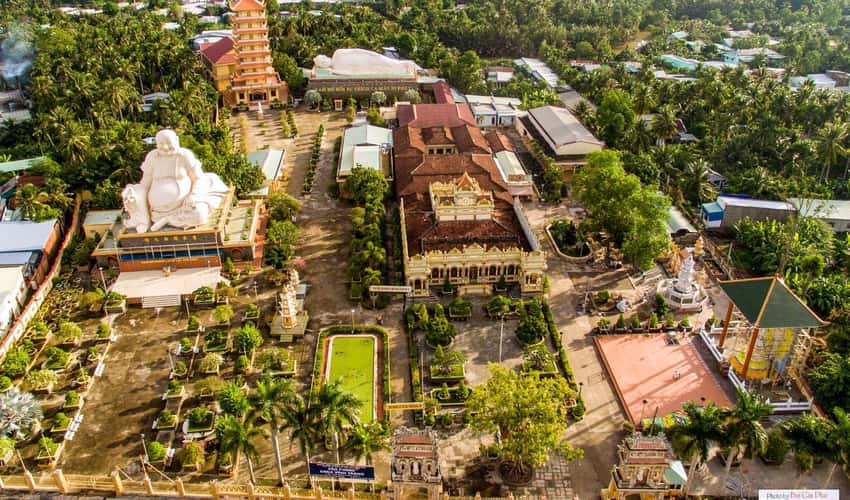

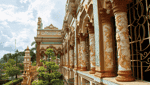

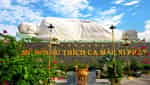
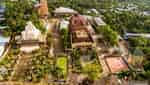

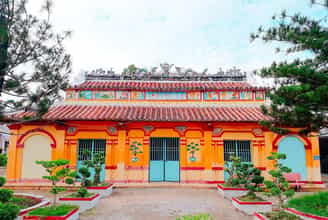
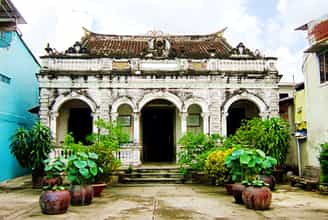
If anyone has once set foot in Tien Giang to enjoy the flavors of Thoi Son island, admire the nature reserve at Dong Tam snake farm but has not admired the beauty combining European and Asian architecture of Vinh Trang pagoda, it cannot be called a complete trip. Vinh Trang Pagoda is the largest Buddhist temple in Tien Giang province, ranked as a national historical-cultural relic in 1984. The pagoda was built in the early 19th century by Mr. and Mrs. Bui Cong Dat. In 1894, Venerable Thich Hue Dang from Giac Lam Pagoda (Gia Dinh) became abbot and organized the construction of a great pagoda and named it Vinh Truong Pagoda with the implication of wishing for the pagoda to be "Eternal to the mountains and rivers, eternal to the heavens and the earth". That's why people in the surrounding area still call it Vinh Trang Pagoda. In 1907, Venerable Tra Chanh Hau repaired the main hall, mixing both Asian and European architectural features. In 1930, Venerable Minh Dang completely restored the pagoda to its current appearance. As a pagoda with the most unique architecture in the South, the highlight of Vinh Trang Pagoda is the three-entrance gate with the art of assembling pieces of porcelain and porcelain. From the colors of ceramics, ancient artisans skillfully arranged many paintings illustrating Buddhist stories, folk tales, themes of four sacred animals, four precious animals, flowers, clouds, sky... with wonderful harmony like a painting. The soft scrolls inscribed with Buddha's names in skillful handwriting: Tran Tinh Mountain Mon, Vast Vow Mon, Pure Land Mysterious Mon... Including four consecutive items (front hall, main hall, ancestral house, back house), the pagoda has an area of 14,000m², 70m long, 20m wide, built of cement and precious wood, 1m high molded foundation, surrounded by solid walls. The front of the street is built in a harmonious European-Asian architectural style with slender columns, curved arches and colorful patterns. Going inside, we will see a shiny golden color applied to the carved images and Buddha statues. Most notable are the pair of dragon pillars in the main hall, which are large round pillars, made of precious wood, architecturally styled in the style of "upper and lower autumn". Looking from a distance, visitors will have the feeling that the pagoda is like a house with European architectural style with slender curved columns, with reliefs of the Eight Immortals riding animals with Renaissance patterns, Roman-style arches, French ironwork, and Japanese ceramic tiles. Inside the main hall and the ancestral house, there are bold Vietnamese architecture, the horizontal panels and wooden statues are skillfully and sophisticatedly carved with joyful and lively images. The space inside the pagoda is home to many fine art works of generations of artisans throughout the North, Central and South. For example, in the middle of the column is a set of blue and eight immortal beasts. This work was created around 1907 - 1908 by local artisans. Compared to the surrounding lamella sets, this set dates back to an earlier date, but has a higher artistic level. This is a rare relief from the early 20th century, proving that visual arts in the South developed quite early. The four pillars of Vinh Trang Pagoda all have dragon pillars hanging from them. The outer pair carved with four sacred animals was donated by Mrs. Le Thi Ngoi in Ba Tri (Ben Tre) in 1909. A special feature is that this pair of dragon pillars has a unique and unique layout: carved with a phoenix standing on a dragon's head. It can be said that the entire beauty of Vinh Trang Pagoda focuses on visual arts, of which statues make up the majority. In particular, at the pagoda there is also a set of statues of eighteen Arhats that are not inferior in terms of art to the statues of Arhats at Tay Phuong pagoda. These 18 statues are located on both sides of the main hall wall, carved from jackfruit wood, each statue is about 0.8m high, with a pillow width of 0.58m. The Arhats all ride animals, holding treasures in their hands. The description of this group of statues also has its own, very Southern appearance, but is successful in describing the typical emotions of each Arhat, proving that in addition to his craftsmanship, the author is also quite knowledgeable about Buddhist teachings. Researcher Truong Ngoc Tuong determined that the most beautiful statues of this pagoda were made by artist Tai Cong Nguyen and his students around the early 20th century. The largest is the Amitabha statue donated by Mr. Tong Huu Trung in Vinh Long. There is also a statue of Ho Dharma Protector promoting good and punishing evil... All represent the pinnacle of the art of round statue carving in the Mekong Delta region. Around the pagoda are ornamental gardens planted with many types of fragrant flowers and exotic grasses, lakes fragrant with lotus scent and ancient trees providing shade, creating a wonderful harmony between the natural scenery and architectural space, making the pagoda more ancient and solemn. Prominent in the middle of the garden is the 24m high Amitabha Buddha statue (pedestal 6m, statue 18m). The white statue depicts the Buddha standing and watching over sentient beings in all realms. The Buddha statue is considered by many locals to be the symbol of the current temple. About 80km from the center of Ho Chi Minh City, Vinh Trang is considered a famous ancient temple and a unique architectural work. It can be said that the beauty of the pagoda focuses on visual art and is also a reflection of the artistic history of the land of Tien Giang. Today, the pagoda has become a must-see tourist destination for domestic and foreign tourists when they have the opportunity to visit My Tho city. Moreover, it is also a place of research for many people when visiting this impressive temple.
Dong Thap From January to December 6923 view
Ngày cập nhật : 01/04/2023



 AI Travelviet